How to Fish Deep Structure for Smallmouth in Fall
Fall fishing in Utah can be a real head-scratcher, especially when those smallmouth bass that were so eager to bite all summer suddenly vanish. You might spend hours casting into the same coves that produced fish just weeks ago, only to come up empty-handed. The frustration is real when you know the fish are there but you just can't seem to find them. This guide is all about demystifying the autumn smallmouth bite, helping you understand why these intelligent fish move deep and, more importantly, how to locate and catch them when they do.
The Seasonal Shift: Understanding Fall Smallmouth Behavior
As the vibrant autumn colors sweep across Utah's landscapes, they bring with them a significant change in the aquatic world. Smallmouth bass, like many other fish species, are highly attuned to these environmental shifts, particularly the dropping water temperatures. What was once a shallow-water feeding frenzy in the summer often turns into a deepwater hide-and-seek game in the fall. Understanding this fundamental behavioral change is the first step to continued success.
Why Smallmouth Move Deep in Fall
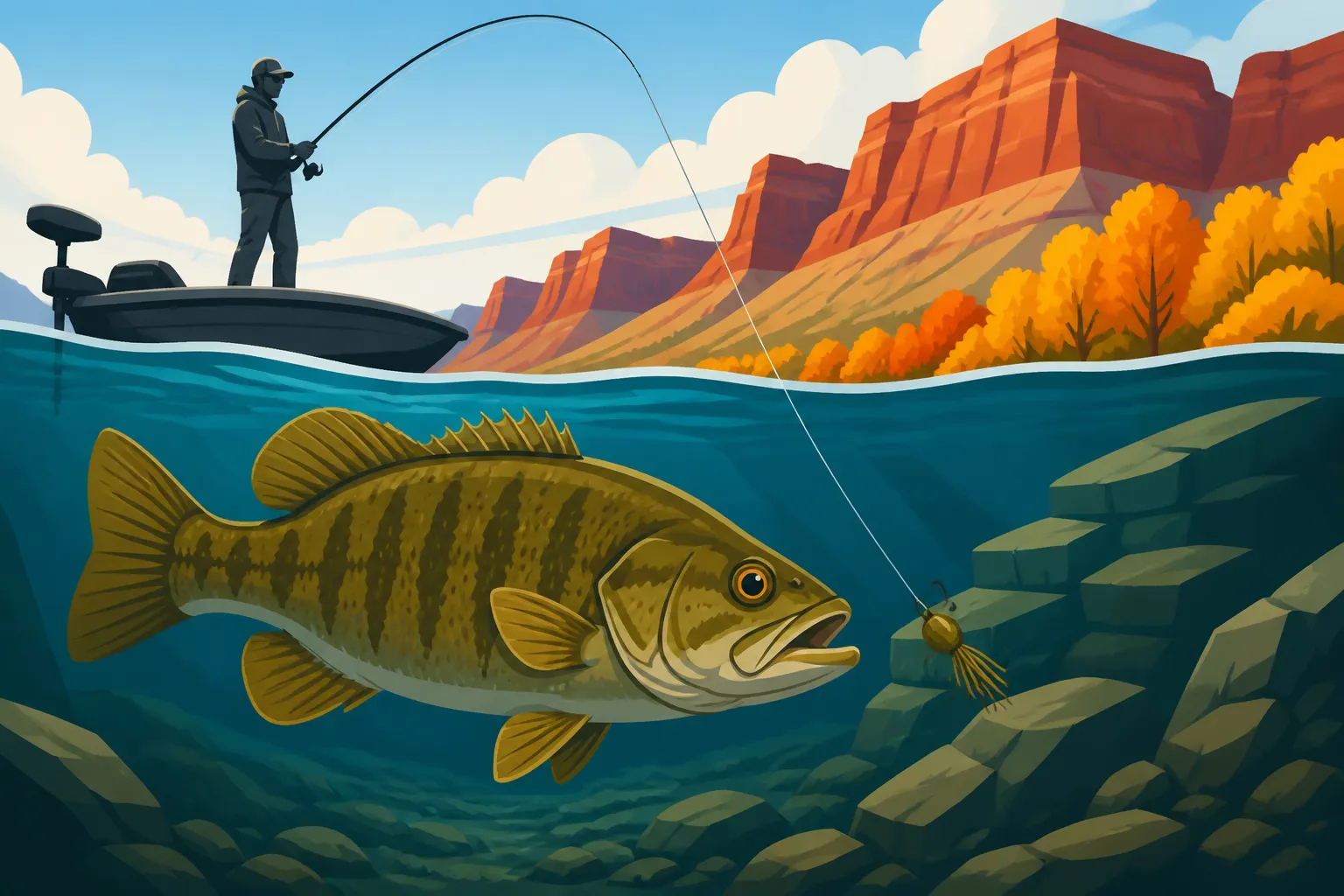
The primary driver behind smallmouth moving deeper in the fall is the relentless drop in water temperature. As the days shorten and nights grow colder, the shallower areas of lakes and reservoirs cool down much faster. Smallmouth, being cold-blooded creatures, seek out more stable and comfortable thermal zones, which are typically found in deeper water. This isn't just about comfort; it's also about metabolism. Cooler water slows their metabolism, making them less inclined to chase fast-moving prey across open flats. Instead, they prefer to conserve energy and hold tight to structure, ambushing unsuspecting baitfish or crayfish as they pass by.
Think about your favorite Utah reservoirs known for smallmouth, like Flaming Gorge or Deer Creek Reservoir. In August, you'd find smallmouth cruising rocky shorelines and shallow points. By October, those same spots might be barren. The fish haven't disappeared; they've simply retreated to where the water temperature is more consistent and where their primary food sources—often schools of baitfish—have also gathered. These baitfish, sensing the colder temperatures, often consolidate into tighter schools and move towards deeper water to escape predators or find more stable thermal conditions themselves. The smallmouth are simply following their dinner, setting up shop in prime ambush locations along ledges, humps, and drop-offs. If you want a more general overview of these magnificent fish, check out our Utah Smallmouth Bass Guide.
Identifying Key Transition Periods
The transition into deepwater smallmouth fishing isn't an overnight switch; it's a gradual process that unfolds throughout the fall. Early fall, typically September in many Utah waters, can still offer some mixed bag fishing, where you might find smallmouth both shallow and deep. During this period, the shallow bite might still be active on warmer, sunny days, especially in the afternoons. However, as October progresses and moves into November, the deep bite becomes increasingly dominant.
A crucial concept to understand during this period is lake turnover. In many temperate lakes, as the surface water cools to match the temperature of the deeper water, the entire water column can mix, or "turn over." This process redistributes oxygen and nutrients, but it can also temporarily disorient fish and make the bite tougher. Once the lake has stabilized post-turnover, the smallmouth will settle into their deepwater patterns. Knowing when your target lake experiences turnover can be a significant advantage. It's similar to How Water Temperature Affects Utah Trout Fishing, but with a unique smallmouth twist. Paying attention to local fishing reports and water temperature readings is vital for pinpointing these key transition windows. The smallmouth will be feeding heavily to prepare for winter, making them a worthy adversary if you can find them.
Decoding the Depths: Locating Prime Deep Structure
Finding smallmouth bass in the vastness of a deep Utah reservoir can feel like searching for a needle in a haystack if you don't know what you're looking for. Gone are the obvious visual cues of summer—surface activity, visible rock piles, or weed beds. In the fall, it's all about understanding what constitutes "deep structure" and how to effectively use your tools to pinpoint those hidden honey holes.
Common Deepwater Haunts
Smallmouth bass are structure-oriented fish, and this doesn't change when they move deep. What does change is the type of structure they prefer and how they relate to it. In deep water, smallmouth will gravitate towards features that offer both cover and access to food lanes. These include:
- Ledges and Drop-offs: These are vertical transitions in depth, often forming distinct lines on a sonar screen. Smallmouth will position themselves along these ledges, facing the deeper water, ready to ambush baitfish that swim up or down the contour. A classic example might be a long, tapering point at Flaming Gorge that eventually drops off into significant depth. Smallmouth might be found anywhere along that slope, but often concentrate where the slope becomes steeper.
- Humps and Submerged Islands: Underwater hills or islands surrounded by deeper water are magnets for baitfish and, consequently, smallmouth. The top of the hump might be 20 feet deep, while the surrounding area is 60-plus feet. Smallmouth will cruise the top and sides, pushing baitfish against the structure.
- Rock Piles and Rubble Fields: While less common in extreme depths, submerged rock piles that offer plenty of nooks and crannies provide excellent ambush points and protection. These are often remnants of ancient landslides or riverbeds.
- Submerged Timber and Brush Piles: If your reservoir has old flooded timber or artificial brush piles, these can be prime holding areas. The wood provides cover and acts as a focal point for baitfish. However, fishing these can be tricky due to potential snags.
- Transition Zones: Always look for areas where different types of bottom meet—rock to mud, gravel to sand. These subtle changes can create current breaks or attract different types of forage, making them appealing to smallmouth.
Remember that smallmouth in the fall don't typically scatter across vast deep flats. They'll hold tight to these specific features, often in schools. Once you find one, you're likely to find more. Reservoirs like Jordanelle Reservoir also have excellent smallmouth populations that will follow these patterns.
The Role of Electronics in Finding Fish
Attempting to fish deep structure effectively without modern electronics is like trying to navigate a dark room blindfolded. Your fish finder, often the most expensive piece of equipment on your boat, earns its keep tenfold in the fall.
- 2D Sonar: This is your bread and butter for identifying changes in bottom contour, finding humps, and seeing individual fish or bait balls. Learn to read the arches and lines on your screen to distinguish between fish, bait, and structure.
- Down Imaging (DI) and Side Imaging (SI): These technologies offer photographic-like views of the bottom directly beneath (DI) or to the sides (SI) of your boat. Side Imaging, in particular, is revolutionary for deepwater fishing. You can scan vast areas to either side of your boat, pinpointing submerged rock piles, timber, or ledges that might be 50-100 feet off your path. This saves immense time and helps you map out an area quickly without having to drive directly over every piece of structure. Many anglers use Humminbird or Garmin units, which are readily available through retailers like Amazon, to gain this edge. If you're new to the game, learning How to Read a Fish Finder for Utah Reservoirs is crucial for maximizing your chances.
- GPS and Mapping Chips: Once you locate a promising piece of structure or mark fish, use your GPS to drop a waypoint. This allows you to return to the exact spot precisely, cast from different angles, and drift over it repeatedly. High-definition mapping chips that show detailed contour lines are invaluable. They allow you to anticipate where ledges and humps might be, helping you plan your search patterns more efficiently. Plotting your course to follow a specific contour line at a certain depth can be incredibly effective.
By combining your knowledge of smallmouth behavior with the power of modern electronics, you transform from a random caster into a highly efficient, structure-hunting predator, just like the bass you're pursuing.
Equipping for Deepwater Success: Gear and Lures
Fishing deep for smallmouth in the fall requires a slightly different approach to gear than your typical summer shallow-water setup. Sensitivity, durability, and the right lure selection become paramount. You need to be able to feel the most subtle bites and get your offerings down to where the fish are holding without excessive effort.
Rods, Reels, and Line for Deep Structure
- Rods: Look for spinning or baitcasting rods in the 6'10" to 7'6" range with a medium-heavy power and a fast or extra-fast action. The length helps with casting distance and managing line, while the medium-heavy power provides the backbone needed to effectively work heavier deepwater lures and muscle bigger smallmouth out of cover. The fast action is crucial for sensitivity, allowing you to feel subtle bottom changes and light bites in deep water. Graphite rods are generally preferred for their superior sensitivity.
- Reels: For spinning setups, a 2500-3000 size reel is a good all-around choice, offering a decent line capacity and smooth drag. For baitcasting, a reel with a higher gear ratio (7.1:1 or higher) can be advantageous, allowing you to quickly retrieve slack line, which is critical when a fish picks up your bait and swims towards you, especially in deep water.
- Line: This is arguably the most important component for deepwater sensitivity.
- Main Line: 10-15 lb braided line is an excellent choice for your main line due to its zero-stretch properties, which translates to incredible sensitivity. It also has a smaller diameter than mono or fluoro of the same breaking strength, which helps with deeper dives and less water resistance.
- Leader: Always tie a 6-10 lb fluorocarbon leader to your braided main line. Fluorocarbon is nearly invisible underwater, extremely abrasion-resistant, and offers superior sensitivity compared to monofilament. The low stretch of fluoro is vital for feeling bites and getting solid hooksets in deep water. If you want to dive deeper into line choices, check out our Best Fishing Line for Utah Bass guide. You can find a wide selection of braided and fluorocarbon lines on platforms like Amazon.
Lure Selection for Fall Deepwater Smallmouth
When smallmouth are deep, presentation is everything. You need lures that can reach those depths efficiently and entice a bite from fish that might be less aggressive than their summer counterparts.
- Jigs (Football and Hair Jigs):
- Football Jigs: These are fantastic for deep structure. Their football-shaped head helps them stand up on the bottom and resist snagging in rocky terrain. Tip them with a soft plastic trailer (craw, grub, creature bait). Work them with a slow drag or short hops, letting them crawl over the rocks. Weights typically range from 3/8 to 3/4 ounce.
- Hair Jigs: Often overlooked, hair jigs (especially bucktail or marabou) offer a subtle, natural presentation that can be deadly on finicky smallmouth. They mimic baitfish or crayfish. Fish them with a slow, gentle retrieve or short hops off the bottom. Weights from 1/4 to 1/2 ounce are common.
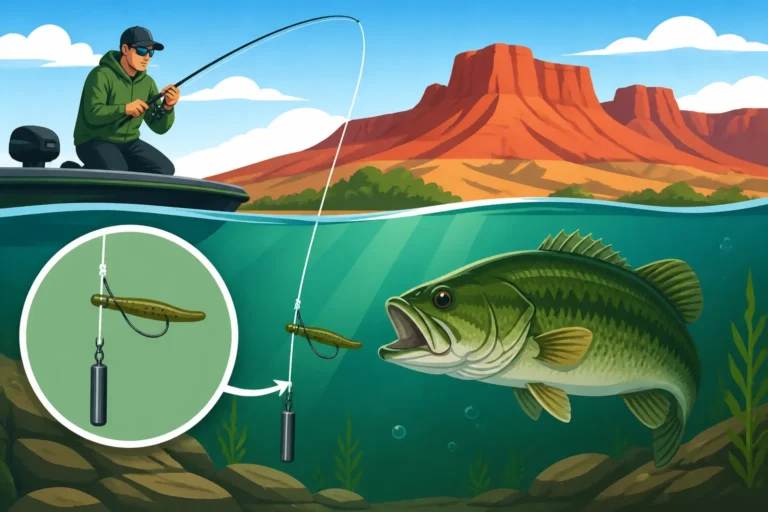
- Drop Shots: The drop shot rig is a deepwater smallmouth assassin. It allows you to present a small, soft plastic bait (like a minnow imitation, worm, or grub) directly in the fish's face, keeping it suspended at a precise depth above a lead weight. This vertical presentation is incredibly effective for lethargic fish. Our How to Fish a Drop Shot Rig for Utah Bass article offers a full breakdown.
- Ned Rigs: Though often associated with finesse fishing, a slightly heavier Ned Rig (1/4 to 3/8 ounce jig head with a small plastic stickbait) can be deadly in deeper water. Its unique mushroom-shaped head allows it to stand straight up on the bottom, presenting a tantalizing meal. Work it with a super-slow drag or subtle shakes.
- Blade Baits: Lures like the Heddon Sonar or Rapala Rippin' Rap can be incredibly effective for aggressive smallmouth. These vibrating metal baits can be vertically jigged over deep structure, mimicking a fleeing baitfish. The vibration and flash can call fish in from a distance.
- Deep Diving Crankbaits: While not a "vertical" presentation, deep diving crankbaits can be used to cover larger areas of deep structure, especially along long tapering points or humps. Look for models that dive to 15-25 feet or more. Crawfish or natural baitfish patterns are often best in the fall. If you're targeting Flaming Gorge specifically, you might want to consider Best Crankbait for Smallmouth Bass at Flaming Gorge.
When choosing colors, lean towards more natural tones in clear Utah waters: greens, browns, watermelon, pumpkinseed for soft plastics, and natural baitfish patterns (shad, perch) for hard baits. For a more comprehensive list of lures, check out Best Lures for Utah Smallmouth Bass.
Here's a quick comparison of some popular deepwater lures:
| Lure Type | Best Use Case | Typical Depth Range | Retrieve Style | Key Advantage |
|---|---|---|---|---|
| Football Jig | Rocky bottoms, ledges, humps | 15-40 feet | Drag, hop, crawl | Mimics crayfish, good feel through rock |
| Hair Jig | Finicky fish, clear water, subtle presentation | 10-35 feet | Slow retrieve, light hops, dead sticking | Natural action, minimal disturbance |
| Drop Shot | Suspended fish, precise depth targeting | 10-50+ feet | Shaking, light lifts, dead sticking | Suspends bait perfectly in strike zone |
| Ned Rig | Finesse, pressured fish, subtle bites | 10-30 feet | Super slow drag, slight shakes | Stands up on bottom, subtle movement |
| Blade Bait | Active fish, vertical jigging, covering water | 10-60 feet | Lift-fall, rip-pause | Strong vibration and flash, calls fish from distance |
| Deep Diving Crank | Covering large areas, hitting specific depths | 15-30+ feet | Constant retrieve, deflection | Efficient search bait, covers water quickly |
Tactical Approaches for Fall Deep Structure Smallmouth
Now that you understand where smallmouth go and what gear to use, it's time to put it all into action. Fishing deep structure effectively requires patience, precision, and a willingness to adapt your presentation to the mood of the fish.
Mastering Vertical Presentations
When smallmouth are holding tight to deep structure, often in less aggressive moods, vertical presentations become incredibly potent. These techniques keep your lure in the strike zone longer and offer a more subtle, enticing meal.
- Drop Shot Techniques: This is a go-to for a reason. Once you've marked fish or promising structure on your sonar, position your boat directly over or slightly upwind from the target. Drop your drop shot rig straight down. Let the weight hit the bottom, then reel up any slack until your line is taut and your bait is suspended at the desired depth (often 6 inches to 3 feet off the bottom, or at fish level if you see them on sonar).
- Detecting Bites: Smallmouth bites on a drop shot are often very subtle in cold water. It might feel like a slight "tick," added weight, or simply a spongy feeling. Don't set the hook with a sweeping motion; instead, reel down until you feel the weight of the fish and then simply lift the rod to drive the hook home. Experiment with different weights (1/4 to 1/2 ounce are common) to maintain bottom contact in wind or current.
- Presentation: Once your bait is at depth, the key is minimal movement. Gently shake your rod tip to impart subtle action to the bait. Let it sit motionless for extended periods. Sometimes, the fish will hit it on the fall or when it's just sitting there.
- Jigging Spoons and Blade Baits: These lures are fantastic for active smallmouth that are still willing to chase. Drop them to the bottom, then aggressively rip them up 2-4 feet before letting them flutter back down on a semi-slack line. Most bites will occur as the lure falls.
- Yo-Yo Retrieve: This classic technique involves lifting the rod tip sharply, then lowering it to let the lure fall. Adjust the height of your lift based on fish activity.
- Finding the Right Depth: Use your sonar to see how fish react to the lure. If they're coming up to hit it, you might be able to work it higher in the water column. If they're hugging the bottom, keep your movements closer to the lake bed. This is where a good fish finder really shines, allowing you to track your lure and the fish simultaneously.
- Ned Rig Fishing (Deep Application): While typically a shallow water finesse bait, a heavier Ned Rig is surprisingly effective deep. The key is extreme patience. Drop it to the bottom, and then simply drag it. That's right, just drag it slowly along the bottom, occasionally pausing for several seconds. The mushroom head and buoyant plastic cause the bait to stand up tantalizingly. Bites can be incredibly light, so watch your line for any twitch or movement.
Covering Water Effectively with Deep Divers
While vertical presentations are excellent for precise targeting, sometimes you need to cover more water to locate those schooling smallmouth. Deep diving crankbaits can be your best friend in these situations.
- Deep Diving Crankbaits: These lures are designed to get down quickly and dig along the bottom, deflecting off structure and triggering reaction strikes.
- Casting and Retrieving: Cast your deep diver as far as possible, then immediately crank it down to its maximum depth. The goal is to make the lip of the crankbait occasionally "grind" into the bottom or deflect off rocks and ledges. This erratic action often triggers strikes. Vary your retrieve speed: sometimes a fast, steady retrieve works, other times pauses and changes in speed are more effective.
- Hitting Structure: Pay close attention to your electronics to identify underwater points, humps, or rock piles. Position your boat so you can cast your crankbait to intersect these features. The moment your crankbait hits a rock, pause it briefly—that's often when a smallmouth will strike.
- Targeting Specific Zones: With a deep diver, you're not just casting aimlessly. You're using the lure to systematically explore a depth range. For example, if your sonar shows fish holding in 20-25 feet of water along a submerged point, choose a crankbait that dives to that specific depth.
- Trolling (Limited Application): While less common for fall smallmouth than for other species, slow trolling a deep diving crankbait or even a large grub on a jig head can be an effective way to cover vast deep flats or long points, especially on large bodies of water like Flaming Gorge. The goal isn't necessarily speed, but consistent depth and presentation. This can be especially useful if the fish are scattered or if you're trying to quickly locate a school.
Remember, fall smallmouth can be finicky. Don't be afraid to experiment with different lure colors, retrieve speeds, and presentation styles until you find what they prefer on any given day. The rewards of cracking the deepwater smallmouth code are well worth the effort.
Disclaimer
This article is for general informational purposes only and does not constitute professional advice. Laws, prices and regulations vary by location and change over time. Consult a qualified professional for guidance on your specific situation.