What Is Fall Turnover and How Does It Affect Fishing?
Oh, the fall! It's such a beautiful time in Utah, with the leaves turning vibrant colors and the crisp air beckoning us outdoors. But for many anglers, myself included, there's a certain mystery and frustration that comes with fishing Utah's reservoirs this time of year. One day the fish are biting, the next it feels like they've vanished into thin air. That sudden change in fish behavior is often due to a phenomenon called fall turnover, and it can definitely make you scratch your head. This guide is here to unravel that mystery, explaining exactly what fall turnover is, why it happens, and most importantly, how you can adapt your fishing strategies to keep catching fish even when the lake is turning on its head.
Understanding Fall Turnover in Utah Reservoirs
Before we dive into how it affects your fishing, let's get a good grasp on what fall turnover actually is. It sounds complex, but at its heart, it's a natural process driven by temperature changes that happens in many of our deeper lakes and reservoirs here in Utah, like Strawberry Reservoir, Deer Creek Reservoir, or even some of the deeper sections of Jordanelle Reservoir. Think of it as the lake pressing a giant reset button after a long, hot summer.
The Science Behind Lake Stratification
During the warm summer months, our Utah lakes develop distinct layers, a process known as thermal stratification. Imagine a three-layer cake:
- Epilimnion: This is the top layer, the warmest and most oxygenated water, where you've likely been enjoying your summer swims and fishing in the upper water column. It's constantly interacting with the air and sunshine.
- Metalimnion (or Thermocline): Just below the epilimnion is the metalimnion, characterized by a rapid drop in temperature. This is the "thermocline," a narrow band where the warm water abruptly meets the colder water below. It's a critical layer for fish, often holding baitfish and predatory species seeking comfortable temperatures and food.
- Hypolimnion: This is the deep, cold, and often oxygen-depleted bottom layer. Because it's cut off from the surface, oxygen isn't replenished, and decaying organic matter can consume what little is there. Fish rarely spend much time in the hypolimnion during summer, unless they're species specifically adapted to low oxygen or seeking very cold temperatures with adequate oxygen in unique circumstances.
This layering creates a kind of barrier. The different densities of the warm and cold water prevent them from mixing, much like oil and water. Fish will often orient themselves around the thermocline, looking for that "sweet spot" of temperature and oxygen. If you've ever found fish holding at a specific depth on your fish finder in summer, it was very likely around this layer. For more on how water temperature affects Utah trout fishing, it's worth a deep dive!
The Cooling Process and Water Mixing
As summer gives way to fall, things start to change dramatically. The cooler autumn air, combined with shorter days, gradually lowers the surface water temperature. This is where the magic (or headache, depending on your perspective) begins.
As the epilimnion cools, its water becomes denser. Unlike most substances, water is densest at about 39 degrees Fahrenheit (4 degrees Celsius). When the surface water cools down to a similar temperature as the layers below, it loses its buoyancy advantage. The colder, heavier surface water then begins to sink. This sinking action pushes the slightly warmer, less dense water from below upwards. It's a slow, churning process that gradually breaks down the thermal barrier of the thermocline.
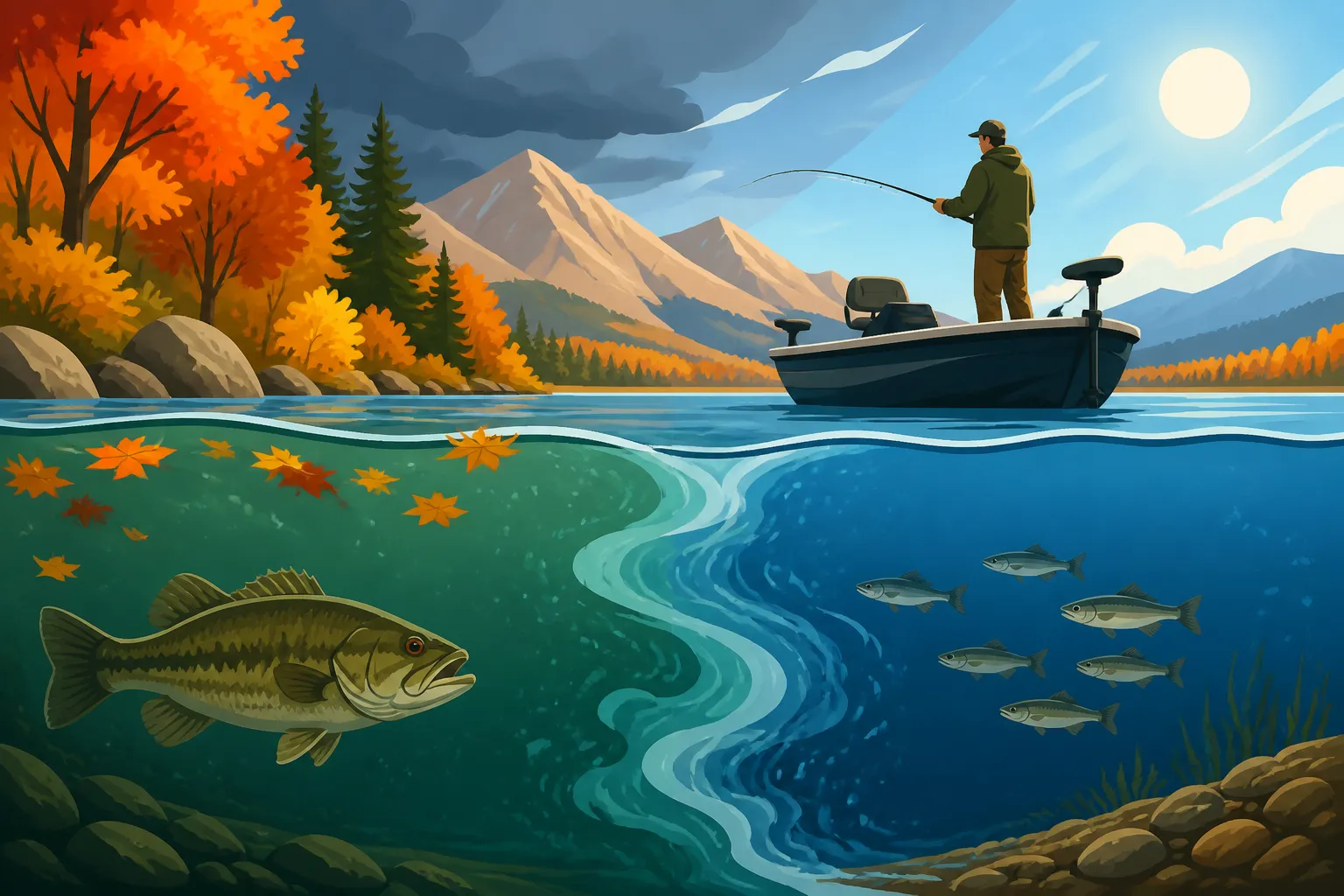
Eventually, typically in mid to late fall, the entire water column reaches a relatively uniform temperature from top to bottom. Once this happens, the lake can "turn over" completely. The water from all depths mixes, distributing oxygen and nutrients more evenly throughout the entire lake. This mixing process can last anywhere from a few days to a couple of weeks, depending on the size and depth of the lake, and the prevailing weather conditions. During this time, the water might look murkier due to stirred-up sediments and organic matter, making you wonder what's going on beneath the surface.
How Fall Turnover Affects Fish Behavior and Location
So, now that we know what fall turnover is, let's talk about why it sends shivers down an angler's spine (or at least makes them pull out their hair). This massive mixing event completely reshuffles the deck for the fish, forcing them to adjust to a brand new environment.
Dispersed Fish and Challenging Conditions
The most significant impact of fall turnover on fishing is that fish become incredibly dispersed. In the summer, fish are often concentrated at specific depths around the thermocline, or near oxygenated areas. Turnover eliminates these distinct thermal and oxygen boundaries. Suddenly, the entire water column has a similar temperature and oxygen level. This might sound good, but for the fish, it means their comfortable summer haunts are gone, and they can now roam freely anywhere from the surface to the bottom.
This dispersion means that instead of finding fish concentrated in predictable zones, they can be spread out over vast areas and depths. It's like trying to find a needle in a haystack, or a single cookie in a giant empty house. This validation of frustration is real; I've spent many a fall day wondering where all the fish went! The baitfish, which larger predators like trout, bass, and walleye rely on, also scatter, making it harder for predators to find easy meals. This can make them less active and harder to entice.
On top of the dispersion, the actual turnover process itself can be quite disorienting for fish. The sudden changes in water chemistry, temperature, and even light penetration (due to stirred-up sediment) can put them off feeding. Many anglers report a significant slowdown in bites during the peak of turnover. You might be out there with your favorite lures, wondering why nothing is working, and the answer is simply that the fish are either too scattered to find or too "out of sorts" to bite.
Short-Term Slowdown vs. Post-Turnover Opportunities
It's crucial to understand that there's a difference between fishing during the active turnover and fishing after the lake has settled. The immediate aftermath, when the water is actively mixing and churned up, is often the toughest time to fish. The fish are adapting, and visibility can be poor.
However, once the lake has fully turned over and the water clears up again, a new set of opportunities emerges. While fish are still dispersed, they will eventually settle into new patterns. The entire water column is now habitable, meaning you might find fish in depths you wouldn't typically target in summer. This period, often extending into late fall and early winter, can offer some fantastic fishing if you know how to adjust.
Many veteran anglers know that while the turnover event itself can be challenging, the post-turnover period can be very productive. Fish will begin to feed more actively as they become accustomed to the new conditions and start to bulk up for the colder months ahead. It's a matter of figuring out their new preferred zones and presentations, which often requires a bit more effort and experimentation than typical summer fishing. If you're wondering how to fish a Utah reservoir after turnover, this guide will definitely help you shift your mindset and tactics.
Adapting Your Fishing Strategy for Post-Turnover Success in Utah
Alright, so the lake has turned over, the fish are scattered, and your usual tactics aren't working. Don't pack up your gear just yet! This is where your angling skills truly get to shine. Adapting to post-turnover conditions is all about being versatile, patient, and willing to experiment.
Covering Water and Searching for Active Fish
Since fish are dispersed, your primary goal is to find them. This means covering a lot of water and experimenting with different depths and areas. Trolling is often a highly effective strategy immediately after turnover because it allows you to present your lure through various depths and across wide swathes of the reservoir. You can use different lure types at different depths on multiple lines if regulations allow, increasing your chances of finding that magic combination. If you're trolling for species like lake trout, understanding Utah trolling techniques for lake trout will be invaluable.
For shore anglers or those in smaller boats, casting and retrieving repeatedly in different directions can help you cover a fan-shaped area. Don't just cast to the same spot; explore the shallower edges, deeper drop-offs, and open water. Consider targeting areas with distinct structural features like submerged points, humps, creek channels, or sharp drop-offs. While fish might be anywhere, they will eventually gravitate toward structure that offers ambush points or access to food.
Your fish finder becomes an even more critical tool during this time. Instead of looking for a dense thermocline, you'll be scanning for scattered individual fish marks or, ideally, bait balls that indicate where predators might be lurking. Pay attention to any subtle temperature changes your fish finder might detect, even if not a distinct thermocline, as fish might still prefer certain thermal zones. Learning how to read a fish finder for Utah reservoirs effectively will give you a significant advantage.
Preferred Baits and Lures for Post-Turnover Conditions
With scattered fish and potentially murkier water, your bait and lure choices need to be re-evaluated. Slower, more enticing presentations often work better when fish aren't aggressively chasing.
- Live Bait: Worms, minnows (where legal, always check Utah bait fish rules for live bait), or even corn for trout can be incredibly effective. Fish them slowly, either under a bobber or on the bottom with a minimal weight, allowing them to drift naturally. The natural scent and movement can draw in fish that might ignore artificial lures.
- Jigging: Vertical jigging with spoons, blade baits, or soft plastics can be a killer technique. Lower your lure to different depths, give it a few jigs, then let it sit. The flash and vibration, followed by a pause, can trigger bites from hesitant fish. For trout specifically, knowing how to rig a jig for Utah trout can make a big difference.
- Scented Baits: PowerBait, Gulp!, or other scented artificial baits become extremely useful. The added scent trail helps fish locate your offering in lower visibility or when they're not actively hunting by sight. You can find a wide variety of these baits on platforms like Amazon, making it easy to stock up before your trip.
- Lure Colors: While clarity is still good, natural colors are often best. However, if the water is murky from the turnover, don't be afraid to try brighter, more contrasting colors like chartreuse, orange, or even glow-in-the-dark options. These can provide better visibility in stained water.
- Slow Presentations: Whether you're using crankbaits, swimbaits, or spinnerbaits, retrieve them slower than you might in summer. Fish often conserve energy in cooler water and might be more willing to strike a slow, easy meal. For species like smallmouth bass, knowing the best lures for Utah smallmouth bass and presenting them slowly can yield great results.
Timing Your Fall Fishing Trips for Optimal Results
Patience is a virtue when fishing after turnover. Don't expect immediate results. Give the fish some time to adjust, and try to time your trips for conditions that might make them more active.
- Stable Weather: Avoid fishing immediately after a major cold front. Stable, consistent weather patterns, even if cool, are generally better. Fish often become more active as barometric pressure stabilizes.
- Mid-Day Warmth: While many anglers prefer dawn and dusk in summer, the mid-day hours (late morning to mid-afternoon) can be productive in the fall. The sun has more time to warm the upper water column slightly, which can increase fish activity, especially for species like trout and bass. This is particularly true for those sunny, bluebird days. Knowing the best time of day to fish for Utah trout can really pay off in these conditions.
- Post-Turnover Clear-up: Wait for the water to begin clearing up after the initial mixing. The clearer the water, the more comfortable the fish will be, and the better they'll see your presentation.
- Early Fall vs. Late Fall: The actual turnover typically happens in mid-fall. Fishing just before it or a week or two after it's settled can be very productive. As you transition into late fall, the water will be consistently cold, and fish will have fully adapted to their winter patterns, which often means holding in deeper water or near drop-offs. This transition is key to understanding Utah fishing seasons explained.
By applying these strategies, you'll be well on your way to enjoying some fantastic fall fishing in Utah, even during this transitional period. Don't let fall turnover discourage you; let it challenge you to become a more versatile and successful angler!
| Condition Aspect | Pre-Turnover (Summer) | During Turnover (Late Fall) | Post-Turnover (Late Fall/Early Winter) |
|---|---|---|---|
| Water Layers | Stratified: Warm top, cold deep, distinct thermocline | Mixing, uniform temperature, murky water possible | Homogeneous: Uniform temperature, clearing water |
| Oxygen Levels | High at top, low at bottom | Redistributed evenly | Evenly distributed |
| Fish Location | Concentrated around thermocline/structure | Dispersed, disoriented, difficult to locate | Dispersed but settling into new patterns, can be deep |
| Fish Activity | Active, predictable feeding windows | Reduced, sluggish, less willing to bite | Increasing activity as fish adapt and feed for winter |
| Visibility | Often clear | Can be reduced/murky | Generally good/improving |
| Angling Challenge | Moderate, targeting specific depths | High, very challenging to find and trigger bites | Moderate, requires covering water and adapting depth |
| Recommended Tactics | Deep trolling, targeting thermocline, structure fishing | Slow presentations, jigging, covering all depths, scent baits | Trolling, jigging, exploring structure, deeper water |
Disclaimer
Please remember that fishing regulations, conditions, and fish behavior can change rapidly. Always consult the latest Utah Division of Wildlife Resources (UDWR) fishing proclamation before heading out on any Utah waters. Be aware of local advisories, especially concerning aquatic invasive species and any consumption limits. Stay safe and enjoy your time on the water!