How to Downrig for Lake Trout
There's nothing quite as frustrating as heading out to one of Utah's incredible reservoirs, knowing there are massive lake trout lurking below, but spending hours casting or trolling without a single bite. These elusive fish often hold in the deepest, coldest parts of the water, making them incredibly difficult to reach with conventional methods. This guide is all about how to master the art of downrigging, an indispensable technique that will get your lures right into the strike zone where those trophy lake trout are hiding, turning those frustrating days into memorable catches.
Understanding Lake Trout Behavior and Habitat in Utah
Before you even think about dropping a line, it's crucial to understand why lake trout behave the way they do in Utah's vast, deep waters. These aren't your typical stocked rainbows cruising the shallows; Mackinaw, as they're often called, are a different beast entirely, driven by cold water and the hunt for specific prey.
Why Lake Trout Go Deep
Lake trout, or Mackinaw, are true cold-water predators. Their physiology is adapted to thrive in water temperatures generally below 55 degrees Fahrenheit (around 13 degrees Celsius). As Utah's reservoirs warm up during the spring and summer months, these fish will retreat to the deepest available thermoclines – those distinct layers where water temperature drops rapidly. This isn't just about comfort; it's about survival and finding their primary food sources.
For much of the year, particularly from late spring through fall, you'll find lake trout in depths ranging from 50 to sometimes over 150 feet, depending on the specific body of water and the time of year. They're following baitfish like kokanee salmon, chub, or sculpin, which also prefer cooler temperatures. If you're fishing warmer, shallower water, you're simply not in their neighborhood, and that's often why anglers get skunked when targeting these magnificent fish. Understanding this deep-water preference is the absolute first step in successfully downrigging for them.
Key Utah Lake Trout Habitats
When we talk about serious lake trout fishing in Utah, two names immediately come to mind: Flaming Gorge Reservoir and Bear Lake. These giants are known for producing not only good numbers but also some truly colossal lake trout, including the state record.
Flaming Gorge is arguably the premier lake trout fishery in the state, straddling the Utah-Wyoming border. Its immense size, incredible depths (over 400 feet in some areas), and healthy populations of kokanee salmon make it an ideal habitat for trophy Mackinaw. Anglers often target specific areas known for deep structure, submerged canyons, and baitfish concentrations, like the area around the dam, Linwood Bay, or the various large coves. The sheer size of this reservoir means fish can be spread out, requiring patience and a good understanding of their movements, especially when considering how deep to fish for lake trout at Flaming Gorge in summer. Bear Lake, on the other hand, is famous for its unique subspecies, the Bear Lake cutthroat trout, but it also holds impressive populations of lake trout, often referred to as "Mackinaw." While not as deep as Flaming Gorge, Bear Lake's cold, clear waters and abundant cisco (a small, schooling baitfish) support a robust lake trout fishery. Fishing here often involves similar deep-water tactics, though the target depths might be slightly shallower, typically ranging from 40 to 100 feet in many productive areas. Knowing the specific nuances of each lake is crucial for success.
The Fundamentals of Downrigging for Lake Trout
So, you've located the deep water, you know where the lakers should be, but how do you get your lure there and keep it there consistently? That's where the magic of downrigging comes in. It's a game-changer for deep-water trolling.
What is a Downrigger and How It Works
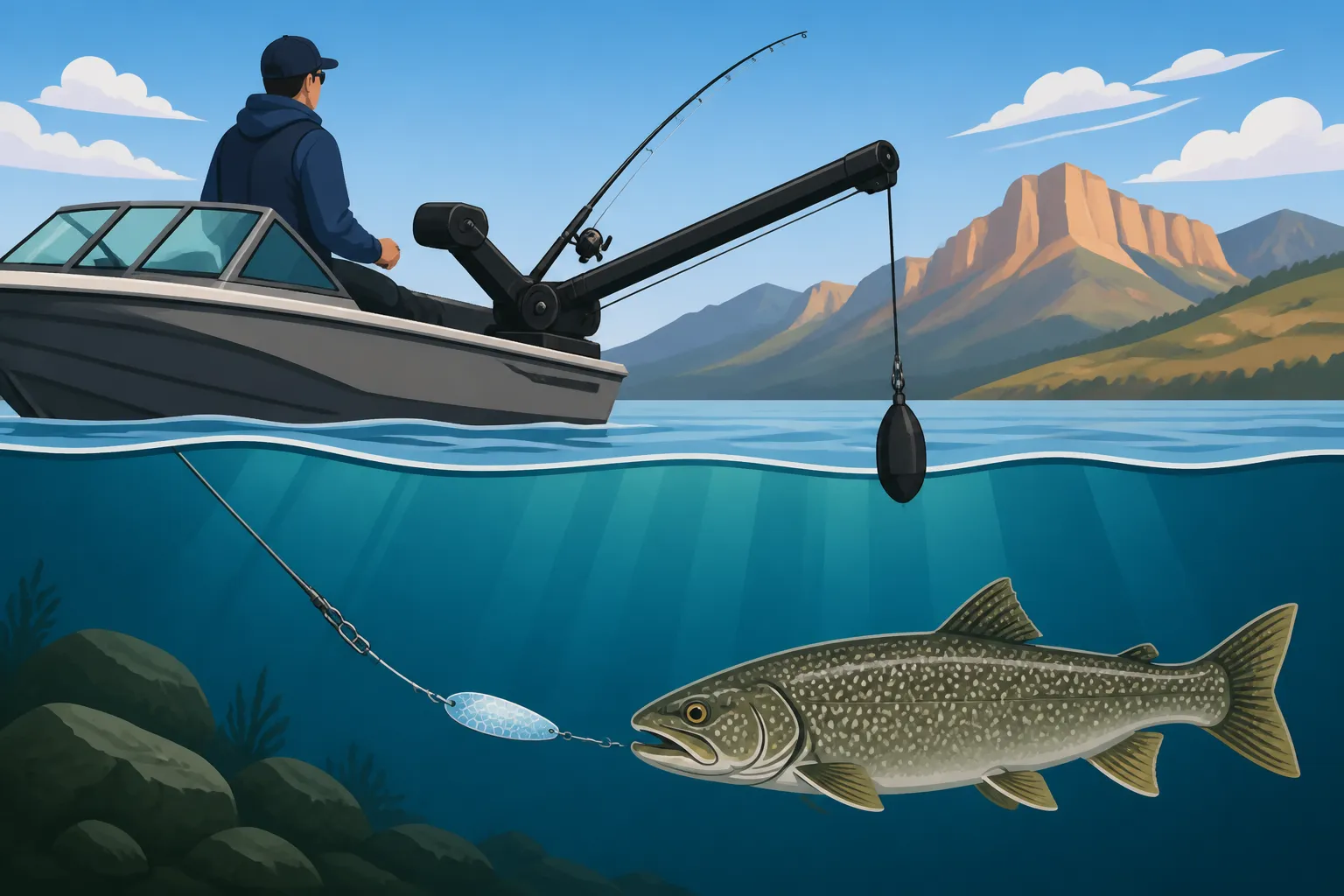
A downrigger is essentially a controlled weight system designed to get your fishing line and lure to a precise depth, then release it to fight the fish freely. Imagine trying to cast a lure 100 feet down and then troll it there – impossible with standard gear! A downrigger solves this problem elegantly. It consists of a sturdy base, a boom, a spool of strong cable (usually stainless steel or braided line), a heavy lead ball or "cannonball" weight (typically 6-12 pounds), and a release clip.
Here's the basic workflow: You tie your lure to your fishing line, let out some line behind your boat (this is called the "setback"), attach your fishing line to the downrigger's release clip, and then lower the downrigger weight to your desired depth. The release clip holds your fishing line to the downrigger cable. When a fish strikes your lure, the tension causes the fishing line to "release" from the clip, allowing you to fight the fish directly without the drag of the downrigger weight. This precision depth control is what makes it so effective for targeting suspended fish like lake trout.
Essential Downrigging Components
To build a functional downrigging system, you'll need several key components working in harmony. Each piece plays a vital role in getting your bait to the fish and ensuring a successful hook-up.
First and foremost, you need the downrigger unit itself. These can range from manual models, where you crank a handle to raise and lower the weight, to electric versions that do the work with the push of a button. For serious lake trout anglers on large waters like Flaming Gorge, electric downriggers from brands like Scotty or Cannon are often preferred for their convenience and speed, especially when running multiple lines or checking depths frequently. You can find a wide range of options on platforms like Amazon. Next, you'll need the downrigger weight, often called a cannonball. These are typically lead, ranging from 6 to 12 pounds. The weight needs to be heavy enough to keep your line at a consistent depth, even when trolling at speed or battling currents. Pyramid shapes are common, but torpedo or round balls also have their advocates. Then comes the release clip, a seemingly small but absolutely critical piece of gear. This clip attaches your fishing line to the downrigger cable. It needs to hold your line firmly enough to prevent accidental releases from boat movement or light bumps, but release cleanly when a fish strikes. Adjustable tension clips are fantastic, allowing you to fine-tune them for different lure sizes and species. Finally, don't forget your downrigger rod and reel. While you could technically use any stout rod, specialized downrigger rods are designed with a softer tip to absorb boat movement and register subtle bites, coupled with enough backbone to handle a large fish. A robust conventional or large spinning reel spooled with strong, abrasion-resistant monofilament or braided line is essential.
Setting Up Your Downrigging System for Success
Getting your downrigging setup dialed in can feel a bit overwhelming at first, but with a systematic approach, you'll be efficiently targeting deep-water lake trout in no time. It's all about matching your gear to the task and the fish you're chasing.
Choosing the Right Downrigger and Rod Setup
When it comes to selecting a downrigger, think about your boat size, budget, and how serious you are about deep-water trolling. Manual downriggers are a cost-effective entry point and perfectly adequate for occasional use or smaller boats. However, if you're frequently fishing large bodies of water like Flaming Gorge, investing in electric downriggers will significantly enhance your experience. Models from companies like Scotty and Cannon offer features such as auto-stop, depth counters, and quick retrieval speeds, which are invaluable when you're making frequent depth adjustments or dealing with multiple lines. Consider the boom length as well; a longer boom helps keep your lines clear of the prop and motor, especially with wider boats.
Your rod and reel combination for downrigging is equally important. Many anglers prefer a medium to heavy action rod, typically 7 to 9 feet long, specifically designed for trolling or downrigging. These rods have a soft tip that flexes under the tension of the downrigger weight, making it easier to see a strike when the rod "snaps" back. The powerful butt section of the rod is then ready to absorb the shock of a big lake trout. For reels, a good quality baitcasting or conventional reel with a reliable drag system and line counter is ideal. Spool it with 20-30 pound monofilament or braid for abrasion resistance and strength. For more specific advice, you might want to look into topics like the best boat setup for trolling at Flaming Gorge.
Selecting Weights, Release Clips, and Lures
The downrigger weight, often a "cannonball," is your ticket to the depths. Most lake trout anglers use weights between 8 and 12 pounds. Lighter weights can "blow back" or rise in the water column more significantly at higher trolling speeds, making precise depth control difficult. For consistency, especially when you're marking fish at a specific depth, heavier is often better. These weights can be purchased at most sporting goods stores or online retailers like Amazon.
The release clip is a small, but vital, piece of equipment. There are several types, including stacker clips (allowing you to run two lines off one downrigger), tension-adjustable clips, and pinch clips. The key is to find a clip that holds your line securely enough to prevent false releases from boat movement but releases reliably when a fish strikes. You want to adjust the tension so that a modest pull (like a fish taking your lure) pops the line free, but it doesn't just fall out. For lures, lake trout at Flaming Gorge and Bear Lake are typically targeted with spoons, plugs, or even baitfish imitations. Popular spoons include those from Luhr-Jensen, Mack's Lure, and various locally tied patterns, often in colors like chrome, blue, green, or chartreuse. Large diving plugs or swimbaits that mimic kokanee or chub can also be incredibly effective. Consider the water clarity and available forage when making your selection.
| Downrigging Component | Typical Size/Type | Key Considerations for Lake Trout |
|---|---|---|
| Downrigger Unit | Electric/Manual | Electric for convenience on large lakes; boom length for boat width. |
| Downrigger Rod | 7-9 ft Medium-Heavy | Soft tip for bite detection, strong backbone for fighting fish. |
| Downrigger Reel | Baitcasting/Conventional | Line counter essential; smooth, powerful drag. |
| Downrigger Line | 20-30 lb Mono/Braid | Good abrasion resistance; clear mono for leaders. |
| Downrigger Weight | 8-12 lb Cannonball | Heavier for precise depth control at speed. |
| Release Clip | Adjustable Tension | Secure hold, reliable release; stacker clips for multiple lines. |
| Lures | Spoons, Plugs, Swimbaits | Mimic local baitfish (kokanee, chub); chrome, blue, green colors. |
Mastering Downrigger Deployment and Retrieval
Getting your lines in the water and keeping them fishing effectively is where the rubber meets the road with downrigging. It's a bit of a dance, especially when you're running multiple lines, but practice makes perfect.
Deploying Your Lines Accurately
The precise deployment of your downrigger setup is paramount for consistent success. First, determine your target depth. This will often come from your fish finder, showing you where the baitfish are schooling or where you're marking individual fish. If you're exploring, start around 60-80 feet and adjust from there. Next, prepare your lure. For lake trout, you'll typically want to let out a "setback" of 20 to 50 feet of line behind the boat before attaching it to the downrigger clip. This setback allows the lure to swim naturally and gives it a wider search pattern behind the boat, often resulting in more strikes.
Once your lure is at the desired setback, attach your fishing line to the downrigger release clip. Make sure the clip is secure but not so tight that it damages your line or prevents a clean release. Then, slowly lower the downrigger weight to your target depth. Many downriggers have a depth counter, which is incredibly helpful for accuracy. As the weight goes down, watch your rod tip. It will bend over as the tension increases. Once the weight reaches the desired depth, the rod tip should remain consistently bent, indicating proper tension. If you're using multiple downriggers, stagger your depths and setbacks to cover more of the water column and avoid tangles. For example, one downrigger might be at 80 feet with a 30-foot setback, while another is at 100 feet with a 50-foot setback. This proactive approach helps in avoiding common issues like tangles, and if you encounter a snag, understanding how to replace a lost Utah fishing license isn't going to help get your gear back.
Troubleshooting Common Downrigger Issues
Even the most experienced anglers encounter hiccups with downrigging. Knowing how to quickly troubleshoot common problems can save a lot of frustration and keep you fishing. One of the most frequent issues is the "false release," where your line pops out of the clip without a fish strike. This can be caused by the clip tension being too light, too much boat bounce in rough water, or even weeds catching on your line. Adjusting the clip tension, slowing your trolling speed, or checking your line for debris can usually resolve this. Conversely, if your line isn't releasing when a fish strikes, the clip tension might be too heavy. Carefully reduce the tension in small increments until it releases reliably.
Another common problem is inconsistent depth. If your downrigger weight isn't staying at the desired depth, it could be due to a too-light weight for your trolling speed, strong currents, or even the downrigger cable slipping on the spool. Check your cable for proper seating, consider a heavier weight, or adjust your speed. Tangles are also a pain, especially with multiple lines. These often occur during turns or when one line is deployed or retrieved too quickly. Always make wide, gradual turns when trolling with downriggers, and ensure lines are staggered in depth and setback. If you're encountering persistent tangles, check your setup for anything that might be causing lines to cross, such as a misaligned downrigger boom or a lure that's spinning excessively. A properly maintained system is key, much like understanding the nuances of Utah trolling techniques for lake trout to avoid issues.
Advanced Downrigging Tactics for Utah's Giants
Once you've got the basics down, it's time to refine your approach and start thinking like a trophy hunter. Advanced techniques will help you zero in on those bigger fish that often require a bit more finesse.
Reading Your Electronics for Optimal Depth
Your fish finder is your most valuable tool when downrigging for lake trout. It's not just for finding fish; it's for understanding the entire underwater environment. Learn to interpret the sonar readings to identify the thermocline, which appears as a distinct band where the water temperature changes rapidly. Lake trout will almost always be found at or below this layer, often suspended just above it or relating to structure within it. Your fish finder will also show you baitfish schools; where the bait is, the predators will follow. Pay close attention to these signals, as they provide real-time information on the best depth to set your downriggers.
Many modern fish finders, especially those from brands like Lowrance or Humminbird, offer advanced features like side imaging or down imaging. These can reveal submerged structure, ledges, and drop-offs where lake trout often ambush prey. Don't just look for fish arches; look for the features that attract fish. Mark waypoints on your GPS whenever you get a bite or see a good concentration of fish or bait. Over time, this data will build a valuable map of productive areas and depths. Regularly checking the screen and adjusting your downrigger depth accordingly, even by just 5-10 feet, can make the difference between an empty cooler and a banner day. Learning how to read a fish finder for Utah reservoirs is a skill that pays dividends.
Multi-Line Downrigging and Spacing
For many serious lake trout anglers, especially on vast waters like Flaming Gorge, running multiple downriggers is standard practice. This allows you to cover more of the water column and experiment with different depths and lure presentations simultaneously. Most boats are set up to run two downriggers, one off each side, but some dedicated setups might include a third "cannonball" off the stern. When running multiple lines, careful spacing is crucial to prevent tangles.
One common strategy is to stagger your depths. For example, if you're running two downriggers, one might be set at 80 feet and the other at 100 feet. You can also vary your setback lengths (the distance from the release clip to your lure) to give your lures different swim paths. Longer setbacks typically mean the lure is running further back and slightly higher than the downrigger weight. Stacker clips are another excellent tool for multi-line fishing. These allow you to attach a second fishing line to the downrigger cable, above the main line. This lets you fish two different depths with a single downrigger, effectively doubling your coverage. Just remember to maintain enough vertical separation between the two stacker lines to prevent tangles, usually 15-20 feet.
Season-Specific Downrigging Adjustments
Lake trout behavior, and therefore your downrigging strategy, will shift throughout the year in response to water temperature, oxygen levels, and baitfish movements.
- Spring (Ice-Off to Early Summer): As the ice comes off, lake trout might still be found relatively shallow (20-60 feet) as the water is still cold throughout the column. They'll often be actively feeding near spawning areas or inlets. Downrigging at these shallower depths can be highly productive. As surface waters warm, they'll begin their descent.
- Summer (Late June to Early Fall): This is prime deep-water downrigging season. Lake trout will be concentrated in the deepest, coldest parts of the reservoir, often 70-150+ feet, following the thermocline and baitfish. Focus on deep structure, points, and areas where bait is schooling. This is when understanding how deep to fish for lake trout at Flaming Gorge in summer becomes critical.
- Fall (Late September to Ice-Up): As the water begins to cool again, lake trout can become more active and might move slightly shallower, especially during turnover. They'll be feeding heavily in preparation for winter. Depths might vary from 50 to 100 feet, but they can still be found deeper. Pay attention to how reservoir drawdown affects where fish hold, as water levels can fluctuate dramatically in Utah.
- Winter (Ice Fishing): While this guide focuses on open-water downrigging, it's worth noting that lake trout are still active through the ice. Ice fishing for lake trout typically involves vertical jigging over deep structure, often in similar depths you'd downrig in open water.
Adjusting your downrigger depths and even your lure presentations based on the season and real-time conditions is the hallmark of a skilled angler.
Safety and Maintenance for Your Downrigging Gear
Like any specialized fishing equipment, downriggers and the associated gear require proper care and attention. Not only does this prolong the life of your expensive equipment, but it also ensures your safety and efficiency on the water.
Downrigger Maintenance Tips
Regular maintenance of your downriggers is crucial, especially given the harsh conditions they often operate in (freshwater, salt, sun, constant use). After each trip, especially if fishing Bear Lake (which has slightly saline water) or if your downriggers are exposed to spray, give them a good rinse with fresh water. This helps remove any corrosive elements and grime. Periodically, inspect the downrigger cable for fraying, kinks, or signs of corrosion. A damaged cable can break under stress, leading to a lost weight or even a dangerous snap. If you see any damage, replace the cable immediately. Stainless steel cables are robust, but some anglers prefer spectra or braided line for its lighter weight and lack of hum.
Lubricate moving parts such as the spool, gears, and pivot points with a marine-grade lubricant. Check all fasteners and bolts to ensure they are tight. The release clips are another critical component; clean them regularly to ensure they function properly. Dirt or corrosion can cause them to stick or release prematurely. If the rubber pads on tension clips wear out, replace them. For electric downriggers, ensure electrical connections are clean and corrosion-free, and check your battery levels. Finally, when storing your downriggers for extended periods, especially during Utah's winter months, clean them thoroughly, apply a protectant, and cover them to prevent dust and UV damage. This proactive approach ensures your gear is always ready for the next big fish.
Boating Safety Considerations When Downrigging
Downrigging, especially with multiple lines and heavy weights, adds another layer of complexity to boating. Safety should always be your top priority. First, always ensure your boat is properly equipped with all required safety equipment, including life jackets for everyone on board, a fire extinguisher, signaling devices, and a first-aid kit. You can review the full list of boat safety equipment required in Utah to ensure compliance.
When deploying and retrieving downrigger weights, be mindful of your hands and fingers. The heavy weights can cause injury if not handled carefully. Always keep clear of the cable and weight when it's moving. Trolling with downriggers means you'll be moving at relatively slow speeds, but it's still essential to maintain situational awareness. Keep an eye out for other boaters, swimmers, and navigational hazards. When making turns, do so gradually and widely to avoid tangling your lines or cutting off other boats. If you're fishing in busy areas, use appropriate signaling flags or lights to indicate you're trolling. Finally, be aware of the weather. Sudden changes in Utah's mountain weather can turn a calm day into a dangerous one. Always check the forecast before heading out and be prepared to head back to shore if conditions deteriorate. A safe day on the water is always a good day, regardless of the catch.
Disclaimer
The information provided in this guide is for general informational purposes only. Fishing regulations, conditions, and best practices can change. Always consult the latest Utah Division of Wildlife Resources regulations before fishing and prioritize safety on the water.