How to Fish a New Reservoir You’ve Never Been To
There’s a unique thrill that comes with fishing a brand-new reservoir in Utah—that expansive, sparkling surface promising untold adventures and, hopefully, some incredible catches. But let's be real: that excitement can quickly turn into a slight feeling of intimidation when you don't know where to start. You’re staring at miles of water, wondering where the fish hide, what they’re biting on, and if you’ll spend the whole day just casting into empty space. This guide is all about equipping you with a strategic approach to tackling an unfamiliar reservoir, turning that apprehension into confidence so you can find those fish and make your trip a resounding success.
Pre-Trip Reconnaissance: Doing Your Homework Before You Go
Before you even load your gear into the truck, a little bit of planning and research can dramatically increase your chances of success on an unfamiliar body of water. Think of it as your secret weapon, allowing you to walk onto that shoreline or launch your boat with a much clearer idea of what lies beneath the surface.
Digital Deep Dive: Online Resources and Maps
In this modern age, the internet is your first and best scouting tool. You have access to a treasure trove of information that can paint a detailed picture of your destination long before you arrive.
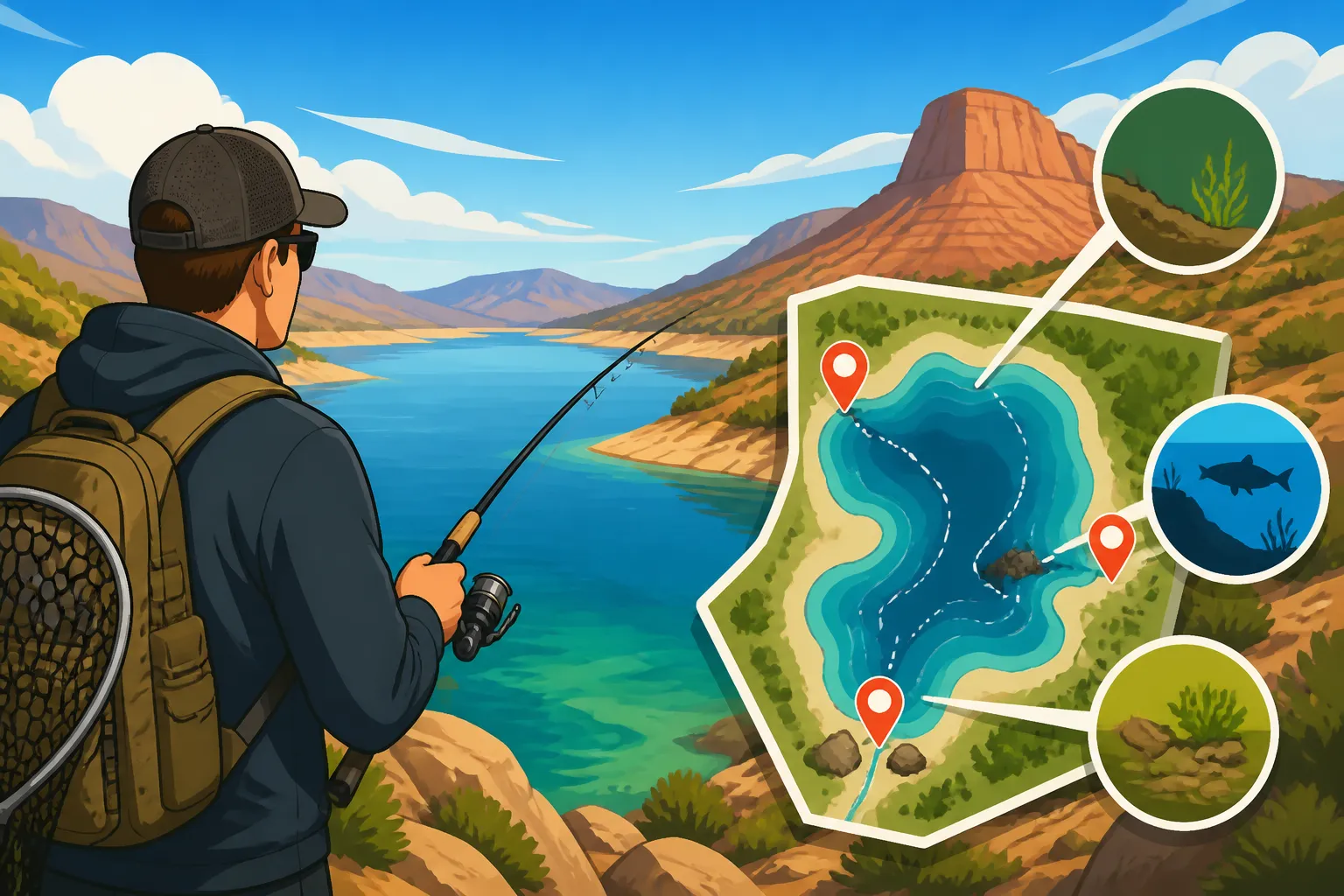
First, pull up some satellite imagery. Google Maps or other mapping services are fantastic for getting a bird's-eye view. Look for features that stand out: old creek channels, riverbeds that fed into the reservoir before it was dammed, points that jut out into the water, submerged islands, and areas where rock slides or timber might have fallen into the water. These are all prime fish habitat. You can often see depth changes indicated by color variations, giving you clues about drop-offs and shallow flats. Imagine finding an old roadbed or a cluster of submerged trees that no one else has bothered to pinpoint; that’s where the fish will stack up! Pay attention to the surrounding topography too—steep canyon walls above water usually mean steep drop-offs below, while gently sloping hillsides might indicate shallower, flatter areas.
Next, make a bee-line for official state wildlife resources. The Utah Division of Wildlife Resources (DWR) website is an invaluable source. They often provide detailed information about the fish species present in specific reservoirs, recent stocking reports, and even historical fishing reports that can give you a sense of seasonal patterns. Knowing if the reservoir is primarily a trout fishery, a bass haven, or known for its walleye will dictate your entire approach. You'll also want to familiarize yourself with Utah Fishing Regulations Explained specific to that body of water, as limits, bait restrictions, or other rules can vary significantly from one lake to another. Check out the How to Find Recent Stocking Reports for Utah Waters to see if the DWR has recently introduced fish, as these freshly stocked trout can be easier to locate and catch, especially in community ponds or smaller reservoirs.
Beyond official channels, don't shy away from online fishing forums and local social media groups. Anglers love to share their experiences (sometimes with a little exaggeration, of course!). You can glean incredible insights into what lures are working, what depths fish are holding at, and general areas that are productive. Just be sure to take every "secret spot" with a grain of salt and cross-reference information if possible. Finally, invest in a good depth map or contour chart for the reservoir if one is available. Many marine electronics manufacturers offer detailed maps that you can load onto your fish finder or view on a tablet. These maps are invaluable for understanding the underwater topography, identifying humps, ledges, and channels that fish use for travel and ambush points.
Species-Specific Research: Knowing What You're After
Knowing what fish species call your chosen reservoir home is fundamental to your strategy. You wouldn't use the same tactics for catching a trophy lake trout as you would for panfish, right? Each species has its own preferences, habits, and seasonal movements.
If you're heading to a lake known for its trout, like Strawberry Reservoir or Flaming Gorge, you'll want to research specific trout behaviors. Rainbow trout might cruise shallower bays or congregate near inlets, especially after a fresh stocking. Brown trout are often more solitary and structure-oriented, preferring rocky cover or submerged timber. Cutthroat trout, like the Bonneville variety, might be found in specific areas of their native waters, often near rocky shorelines. Delve into guides like Utah Trout Species Guide to understand their preferred habitats and feeding habits. Are they primarily eating insects, or are they preying on smaller baitfish? This will inform your lure and bait selection.
Perhaps your new reservoir is famous for its bass, like the smallmouth bass at Flaming Gorge. Understanding Utah Smallmouth Bass Guide techniques means focusing on rocky points, ledges, and submerged boulders. Smallmouth are aggressive predators, often responding well to crankbaits, jigs, or soft plastics fished around structure. Their largemouth cousins, if present, tend to prefer weed beds, lily pads, and fallen timber in shallower, warmer water.
Or maybe you’re targeting walleye, which often means focusing on deeper water, especially during the day, and understanding their light-sensitive nature. Lakes like Utah Lake are renowned for their walleye, and reading a Utah Walleye Fishing Guide would teach you about their preference for rocky humps, submerged points, and feeding during low light conditions or at night. Learning about their preferred forage—often minnows or perch—will also guide your bait choices.
It's also crucial to be aware of any unique regulations or mandatory harvest rules for invasive species. For example, Why Utah Lake Require You to Kill Every Northern Pike? isn't just a suggestion; it's a critical conservation effort to protect native species. Knowing these rules beforehand ensures you're fishing responsibly and legally. This species-specific homework will save you a lot of guesswork on the water, allowing you to start your fishing day with a more targeted approach.
On-Water Scouting: The First Impressions and Adjustments
You've done your homework, driven to the reservoir, and now you're standing on the shore or launching your boat. This is where your observational skills truly come into play. Your initial time on the water isn't just about fishing; it's about active scouting, taking in all the sensory information and using it to formulate your attack plan.
Observation is Key: What to Look For Upon Arrival
Before you even make your first cast, take a few moments to simply observe. Scan the shoreline for obvious features. Are there any visible points, coves, or inlets where streams feed into the reservoir? These are often natural fish attractors because they offer varied habitat, food sources, or temperature breaks. Look for any submerged timber, large rock piles, or areas with distinct weed lines near the shore—these are classic ambush points for many fish species.
Next, pay close attention to the water conditions. What's the clarity like? Is it crystal clear, slightly stained, or muddy? Water clarity impacts how fish see your lure and how deep they might be holding. What color is the water? A greener tint might indicate more algae, which means more plankton, which can draw baitfish. Look for any surface activity: rising fish (especially trout), schools of baitfish flickering near the surface, or even birds diving, which often indicates baitfish being pushed up by predators from below. These are all incredibly valuable clues.
While it's not always wise to follow the crowd, observe where other anglers are focusing their efforts. Are all the boats clustered in one area? Are shore anglers packed onto a particular point? This might suggest a known productive spot or recent activity. Use this information as a potential starting point, but don't feel limited by it. Sometimes the best fishing is found by exploring where others aren't.
Finally, consider the wind. Wind can be a huge factor on reservoirs. It pushes warmer surface water, plankton, and baitfish to the windblown shore, creating a feeding frenzy for larger predatory fish. Strong winds can also create currents and chop, which can position fish in certain areas. Understanding How Wind Affects Fishing on Utah Reservoirs can help you predict where fish might be congregating. Conversely, a completely calm, glassy surface often means fish might be deeper or more cautious.
Starting Broad, Then Narrowing Down: Your Initial Strategy
With your observations in mind, resist the urge to immediately settle into one spot and cast endlessly. On a new reservoir, your initial strategy should be about covering water and gathering more information. Think of it as painting with broad strokes before you start adding the fine details.
If you’re fishing from a boat, trolling can be an incredibly effective way to cover a lot of ground quickly. Set out a few lines with different presentations—perhaps one deeper with a crankbait or spoon, another shallower with a spinner, and vary your lure colors. This allows you to test different depths and patterns simultaneously. Pay attention to your fish finder during this process. A good fish finder will show you not only the depth but also the contours of the bottom, submerged structure, and even schools of baitfish or larger individual fish. Learning How to Read a Fish Finder for Utah Reservoirs is truly a game-changer on unfamiliar waters. Note any sudden drop-offs, humps, or old river channels that weren't visible on your map.
If you’re fishing from shore, fan-casting is your friend. Cast in a wide arc, starting from one side and working your way around, using a versatile lure like a Kastmaster, a soft plastic grub, or a PowerBait rig. Don't be afraid to walk and fish different sections of the shoreline. The goal isn't necessarily to catch a ton of fish in the first hour, but rather to locate areas of activity and identify any immediate patterns.
The first bites you get are gold. Did the fish hit near a specific depth? Was it close to a visible piece of structure? What retrieve speed were you using? Once you get a bite, try to replicate those conditions. If you're catching fish at 15 feet near a rocky point, then focus your efforts on other similar rocky points at that same depth. If they're hitting a specific color, switch more of your lures to that color. Begin with more versatile baits that can appeal to a wide range of species and then specialize once you start getting bites. For instance, a simple worm under a bobber can catch almost anything, while a large swimbait is very species-specific.
Adapting and Experimenting: The Art of the Catch
Once you've done your initial scouting and perhaps even gotten a few bites, the real work of figuring out the reservoir begins. Fishing is rarely a static endeavor; it requires constant adaptation and a willingness to experiment. The fish aren't going to tell you what they want, so you have to play detective.
Depth and Presentation Adjustments
One of the biggest mistakes anglers make on a new reservoir is getting stuck at one depth or with one presentation. Fish aren't always where you expect them to be. If you're targeting the surface and getting no action, it's time to go deeper. Try adding a sinker to your bait, switching to a heavier jig, or using a diving crankbait. Conversely, if you're jigging the bottom without success, fish might be suspended higher in the water column, perhaps feeding on baitfish schools. Try a mid-depth troll, a suspended jerkbait, or a slip bobber rig to present your bait at varying levels.
Experimentation with your retrieve and lure action is also critical. Sometimes, a slow, steady retrieve is what they want. Other times, a fast, erratic retrieve can trigger a strike. Add pauses, twitches, or jerks to your presentation. Think about how a wounded baitfish might behave—it's rarely a smooth, consistent swim. Sometimes that subtle change in cadence is the difference between an empty hook and a bent rod. How to Adjust Technique When Fish Aren't Biting dives into this further, offering strategies for those tough days when the fish seem to have lockjaw. Don't be afraid to cycle through a variety of lures and baits until you find what's working. If you've thrown crankbaits for an hour with no luck, switch to a soft plastic or a jig. A change in color or size can also be incredibly effective.
Understanding Environmental Factors
Fish behavior is heavily influenced by their environment. Being able to read these cues and adjust accordingly is what separates successful anglers from those who get skunked.
Temperature is a huge factor, especially in deeper reservoirs. Most fish have preferred temperature ranges. In summer, the surface water can get too warm, forcing fish deeper to find cooler, more oxygenated water. Conversely, in spring and fall, fish might be more active in shallower, sun-warmed areas. Look for temperature breaks, which are often found near inlets, springs, or where deep and shallow water meet. How Water Temperature Affects Utah Trout Fishing highlights how critical this can be for targeting certain species.
Light conditions play a significant role. Early morning and late evening, often called "prime time," typically offer the best bite windows due to lower light and cooler temperatures. Overcast days can extend these feeding periods, while bright, sunny conditions might push fish into deeper, shadier cover.
Barometric pressure changes can make fish more active or completely shut them down. A falling barometer often precedes a storm and can trigger a feeding spree, while a rising or stable barometer usually means stable fishing conditions. A rapidly falling barometer, however, can make fish lethargic. You might not be able to change the weather, but you can adjust your expectations and techniques.
Wind, as mentioned before, doesn't just create chop; it can create currents and stack baitfish. Often, the windblown side of a reservoir is more productive as fish gather to feed on the concentrated forage. Learning How Wind Affects Fishing on Utah Reservoirs can help you position your boat or yourself on shore to take advantage of these natural dynamics. Look for current lines where debris collects; these are often highways for baitfish and, consequently, their predators.
Gear and Mindset: Essential Tools for Exploration
Beyond the specific techniques, having the right gear and, perhaps even more importantly, the right mindset, are crucial for successfully fishing a new reservoir. You need tools that offer versatility and a mental approach that embraces the unknown.
Versatile Gear for the Unknown
When you're heading to an unfamiliar body of water, you can't be sure what the fish will be biting on, or even precisely what species you'll encounter. This is where a versatile gear setup truly shines.
Start with your rod and reel combinations. Instead of bringing just one setup, consider bringing a few. A medium-action spinning rod with 6-8lb test line is a fantastic all-around choice for many Utah reservoirs, capable of handling everything from smaller trout to respectable bass. You might also want a lighter setup for finesse presentations or a slightly heavier one if you anticipate larger species or plan to troll with heavier gear. A baitcasting setup might be useful if you're targeting larger bass or throwing heavy lures. Make sure your reels are spooled with fresh line—there's nothing worse than losing a fish on old, brittle line.
Your tackle box should be a miniature arsenal of options. Think variety over quantity. Include a good selection of spoons (Kastmasters, Dardevles), crankbaits (both shallow and deep divers), jigs (marabou, curly tail, tube jigs), and soft plastics (worms, grubs, swimbaits). Don't forget various hooks, sinkers, swivels, and perhaps some PowerBait or similar prepared baits, especially if you know the reservoir is heavily stocked with trout. Different colors are also important; what works one day might not work the next. A good starting point would be to ensure you have some natural colors (greens, browns, clear) and some bright attractant colors (chartreuse, orange, pink). For a fantastic overview of essential items, check out Lures Every Beginner's Tackle Box Needs. You can often find great value and variety packs of lures on Amazon to build up your tackle box without breaking the bank.
A reliable fish finder is almost non-negotiable for boat anglers on a new reservoir. It’s your eyes below the surface, revealing depth, contours, and most importantly, the presence of fish and baitfish. Even a basic model can give you a significant advantage. Best Fish Finders for Utah Reservoirs provides an in-depth look at what to look for. For shore anglers, a pair of high-quality polarized sunglasses are a game-changer. They cut through the glare on the water's surface, allowing you to spot submerged structure, weed lines, and even cruising fish that would otherwise be invisible.
Lastly, don't forget the essentials for safety and comfort: life jackets if you're boating (always check Utah Boating and Fishing Rules), a first-aid kit, plenty of water, sunscreen, and layers of clothing, as Utah weather can change rapidly.
The Explorer's Mindset
Perhaps the most crucial "tool" for fishing a new reservoir isn't in your tackle box; it's between your ears. Approach the day with an explorer's mindset.
Embrace the challenge! It's okay if you don't immediately start catching fish. Every cast is a learning opportunity. Think of it as a puzzle you're trying to solve. What did that slight tap feel like? Was that a bite or just a snag? What changed right before that small fish hit your lure? Being observant and analytical will serve you well.
Keep a mental log (or even a small notebook) of what you tried, where you tried it, and what the results were. Did a certain color work better near a particular type of structure? Did fish seem to be at a specific depth during a particular time of day? This information isn't just for this trip; it builds a knowledge base for future visits to this reservoir and even helps you understand new waters with similar characteristics.
Patience and persistence are virtues in fishing, especially on unfamiliar water. It’s easy to get discouraged after a few hours without a bite, but often, just one small adjustment—a change in lure, depth, or location—can turn the entire day around. The reward of cracking the code on a new waterbody, of figuring out its secrets and landing a fish, is immense and far more satisfying than just pulling fish from a known spot.
Finally, always prioritize safety. Know the size and potential hazards of the reservoir. Large reservoirs can get rough quickly, especially in the afternoon. Be aware of weather changes and always have a way to communicate in an emergency. Fishing new water is an adventure, and like all adventures, it's best enjoyed when you're prepared and smart.
Disclaimer
This article is for general informational purposes only and does not constitute professional advice. Laws, prices and regulations vary by location and change over time. Consult a qualified professional for guidance on your specific situation.