How to Anchor a Boat in Wind on a Utah Reservoir
There’s almost nothing more frustrating than getting out on a beautiful Utah reservoir, only to have a sudden gust of wind ruin your perfect fishing drift or send your boat bouncing perilously close to shore. Trying to hold your position in a strong breeze can feel like an impossible task, turning a relaxing day into a constant battle with Mother Nature. This guide is here to walk you through mastering the art of anchoring your boat in windy conditions on Utah's stunning, yet often blustery, waters, so you can focus on fishing, not drifting.
Understanding the Challenge of Wind on Utah Reservoirs
Utah’s stunning mountain landscapes, while beautiful, are also a major contributor to the unpredictable wind patterns many anglers face. You can leave the boat launch on a calm morning, only to have a ferocious squall whip up out of nowhere, making boat control—and especially anchoring—a real headache.
The Unpredictable Nature of Mountain Winds
If you've ever spent a day on Deer Creek, Jordanelle, or even the vast expanse of Flaming Gorge, you know exactly what I'm talking about. The wind doesn't just blow in one steady direction; it swirls, it gusts, it shifts. This is largely due to the surrounding canyons and mountain ranges that funnel and redirect air currents, creating incredibly localized and often violent conditions. One moment you might have a gentle breeze, the next a 30 mph sustained gust that feels like it’s trying to rip your boat from the water. It’s this unpredictable nature that makes standard anchoring techniques sometimes fall short and why understanding these dynamics is so crucial. It's not just "windy," it's Utah windy. For more insights into how these conditions can impact your fishing strategy, check out our article on How Wind Affects Fishing on Utah Reservoirs.
Why a Good Anchor System is Crucial, Not Just a "Rock on a Rope"
Let's be honest, we've all seen someone try to get by with a makeshift anchor, or maybe we've even done it ourselves in a pinch. But when the wind starts howling, a "rock on a rope" is just an invitation for disaster. An inadequate anchor system isn't just an annoyance; it's a serious safety concern. Your boat can drift into rocky shorelines, other anchored vessels, or even out into shipping lanes if you’re on a larger reservoir. Beyond safety, a poor anchor means constantly re-positioning, missing out on that prime fishing structure you worked so hard to find, and spending more time fighting your boat than actually fishing. Investing in and understanding a proper anchor system is non-negotiable for windy Utah waters.
How Wind Affects Your Boat's Position
The way wind affects your boat isn't uniform; it depends a lot on your vessel's design. A high-sided pontoon boat, for example, acts like a giant sail, catching every bit of wind and making it notoriously difficult to hold position. Bass boats, with their lower profiles, might seem less affected, but their flat bottoms can still be pushed around with surprising force. Even a deep-V hull, designed to cut through waves, can be swung wildly off course if the wind catches it just right. The key here is understanding that your boat isn't just being "pushed"; the wind creates complex forces on different parts of your hull and superstructure, often trying to turn your bow into the wind. This understanding helps you anticipate drift and adjust your anchoring strategy accordingly.
Essential Gear for Anchoring in Wind
You wouldn't head out on a big game hunt with a BB gun, and you shouldn't tackle windy Utah reservoirs without the right anchoring gear. Having the proper equipment makes all the difference between a secure hold and a frustrating drift. Our comprehensive Utah Fishing Gear Guide can offer more general insights, but let's dive into the specifics for anchoring.
Choosing the Right Anchor Type for Utah Bottoms
The type of anchor you choose is perhaps the most critical decision you'll make for windy conditions. Different anchors are designed for different bottom compositions, and Utah's reservoirs offer a variety, from soft mud and sand to rocky points and shelves.
- Fluke (Danforth) Anchor: This is a very common and popular choice, particularly effective in soft mud and sand bottoms, which you'll find in many coves and shallower areas of reservoirs like Utah Lake or Willard Bay. Its broad, flat flukes dig deep, offering excellent holding power in these conditions. However, it can struggle on rocky bottoms where it might not get a bite.
- Claw (Bruce) Anchor: Originally designed for offshore oil rigs, the claw anchor is fantastic for a wide range of bottoms, including mud, sand, and rock. It tends to reset easily if it breaks free and its shape helps it dig in well. Many anglers find these to be very versatile for the varied conditions on large reservoirs like Flaming Gorge. You can often find a good selection of these on sites like Amazon.
- River (Navy) Anchor: These anchors, often with four "flukes" that fold out, are good for snagging on irregular rocky bottoms. They are designed to hold by catching onto rocks or other underwater structures. They can be a good option if you know you'll be fishing over significant rock piles or ledges.
- Mushroom Anchor: While primarily used for small boats, kayaks, or as a stern anchor, mushroom anchors are not ideal for primary anchoring in strong winds, especially on larger boats. They hold by suction in soft mud but offer minimal resistance to lateral pull.
When considering the Best Anchors for Utah Reservoir Fishing, it's important to match the anchor to the typical bottom you'll encounter. Sometimes, having two different anchor types on board can be a smart move for adaptability.
The Importance of Proper Anchor Rode (Chain and Rope)
Your anchor is only as good as the rode connecting it to your boat. The rode consists of both chain and rope, and each plays a vital role.
- Chain: This is where many anglers go wrong by skimping. The chain section of your rode is incredibly important for setting the anchor. Its weight helps the anchor dig in horizontally rather than just lifting vertically. It also provides abrasion resistance against rocky bottoms. Without enough chain (a good rule of thumb is a length equal to your boat's length, or at least 15-20 feet), your anchor is far more likely to drag, especially in strong winds.
- Rope (Line): Nylon is generally the preferred material for anchor line due to its elasticity. This "stretch" acts like a shock absorber, cushioning your boat against sudden tugs from waves and wind gusts, preventing the anchor from being violently pulled out of the bottom. Polypropylene rope floats, which can be tempting, but it has very little stretch and will transmit every jarring motion to your anchor, making it much more likely to pull free. Always use marine-grade rope that is appropriately sized for your boat and anchor weight. You can easily find robust anchor rope and chain kits on Amazon.
Windlasses, Anchor Balls, and Other Helpful Accessories
While not always strictly necessary, certain accessories can make anchoring in wind significantly easier and safer.
- Windlass: For larger boats, a powered windlass is a game-changer. It automates the raising and lowering of your anchor, saving your back from the grueling task of pulling hundreds of feet of chain and rope, especially in choppy water. If you're frequently fishing big, windy reservoirs, a windlass is a worthwhile investment.
- Anchor Ball (Anchor Ring): This simple device can be a lifesaver for manually retrieving a stuck or heavy anchor. You simply attach the anchor line to the ball, run it through a ring, cleat it off to your boat, and motor forward past the anchor. The buoy's buoyancy, combined with your boat's momentum, pulls the anchor free from the bottom. This is especially useful for those rocky sections of reservoirs like East Canyon or Rockport.
- Anchor Buddy/Snubber: These stretchy bungee-like devices can be added between your chain and rope, or even between your anchor and a short section of chain. They provide additional shock absorption, further dampening the effects of waves and gusts, helping your anchor stay set.
Step-by-Step Guide to Anchoring Safely in Windy Conditions
Even with the best gear, knowing how to deploy your anchor in the wind is crucial. There's a method to the madness, and following these steps can significantly increase your chances of a secure hold.
Scouting Your Spot and Approaching with the Wind
Before you even think about dropping anchor, take a moment to assess the situation. Observe the wind direction and strength. Look for visual cues on the water, nearby trees, or flags if you're close to shore. Also, consider the bottom contour using your fish finder. Are you over mud, sand, or a rocky shelf? This information will influence how you set your anchor.
When approaching your desired fishing spot, always try to motor against the wind, past your target. This allows you to drift back over the spot as you deploy your anchor, ensuring you don't overshoot. Think of it like this: if the wind is blowing from north to south, and you want to fish a spot, you would motor north of it, then drift south.
The "Set and Watch" Method for Optimal Hold
This isn't a race; patience is key. Once you're positioned correctly upwind of your desired spot, it's time to deploy:
- Drop the Anchor: Don't just throw it. Gently lower your anchor to the bottom. If you just heave it, the chain and rope can foul, preventing the anchor from setting correctly. Let it sink until you feel it hit the bottom.
- Drift Back Slowly: As the anchor hits bottom, slowly back your boat away from the anchor (or let the wind naturally push you). As you drift, pay out anchor line. Don't let the line just pile up; keep a steady tension. You want the anchor to drag along the bottom, giving it a chance to dig in.
- Feel it Dig In: You'll usually feel a distinct "thump" or "clunk" as the anchor digs into the bottom and starts to hold. The boat's movement will slow down significantly.
- Confirm the Set: Once you think it's set, put your engine in reverse (gentle throttle, don't blast it) and slowly pull against the anchor for a few seconds. This mimics the force the wind will exert. Watch your GPS or a fixed landmark on shore. If your boat isn't moving, or is moving very slowly, your anchor is likely well-set. If you're still drifting significantly, retrieve and try again. Sometimes, it takes a couple of tries to get a good bite.
Calculating and Deploying the Correct Scope
"Scope" is the ratio of the length of your anchor rode (the deployed line and chain) to the vertical depth from your boat's bow to the anchor on the bottom. In windy conditions, proper scope is absolutely critical.
For most anchoring in moderate winds, a 7:1 scope is recommended. This means if the water is 10 feet deep, and your bow is 3 feet above the water, your vertical depth is 13 feet. You'd want to deploy 13 feet * 7 = 91 feet of anchor rode.
| Wind Condition | Recommended Scope (Rode Length:Vertical Depth) | Example (10 ft water, 3 ft freeboard) |
|---|---|---|
| Calm | 5:1 | 13 ft * 5 = 65 ft of rode |
| Moderate Wind | 7:1 (Standard) | 13 ft * 7 = 91 ft of rode |
| Strong Wind | 10:1+ | 13 ft * 10 = 130 ft of rode |
Always err on the side of more scope in windy conditions. Too little scope means your anchor line is pulling upwards, making it much easier for the anchor to break free. Too much scope, and you might swing too widely, potentially interfering with other boats or obstructions. It’s a balance you learn with practice, but always prioritize safety.
Troubleshooting Common Anchoring Problems in Wind
No matter how well you prepare, anchoring in wind can still present challenges. Knowing how to react when things go awry is just as important as knowing how to set a good anchor.
What to Do When Your Anchor Drags
The dreaded anchor drag. You feel that slow, relentless drift, or worse, see your GPS track showing you're moving despite being anchored. Don't panic, but act quickly.
- Increase Scope: This is your first and often most effective solution. Pay out more line, even if it means going past your ideal 7:1 or 10:1 ratio. The longer the line, the lower the angle of pull on the anchor, allowing it to dig in deeper. Continue to let out line until you feel the anchor reset and the boat slows its drift.
- Increase Engine Reverse (Carefully): If increasing scope doesn't work immediately, engage your engine in reverse with a bit more throttle, gently pulling against the anchor to help it dig in. Be cautious not to overdo it and risk pulling the anchor completely free or fouling your propeller with your own line.
- Relocate: If your anchor simply won't hold in a particular spot, it might be due to the bottom composition (e.g., trying to hold a Danforth on solid rock). Retrieve your anchor and move to a new spot, ideally one with a different bottom or more shelter from the wind. Sometimes, even moving 50 yards can make a huge difference.
Dealing with Anchor Fouling (Getting Stuck)
Snagging your anchor on a submerged log, rock, or old fishing gear is a common problem, especially in older reservoirs or those with irregular bottoms.
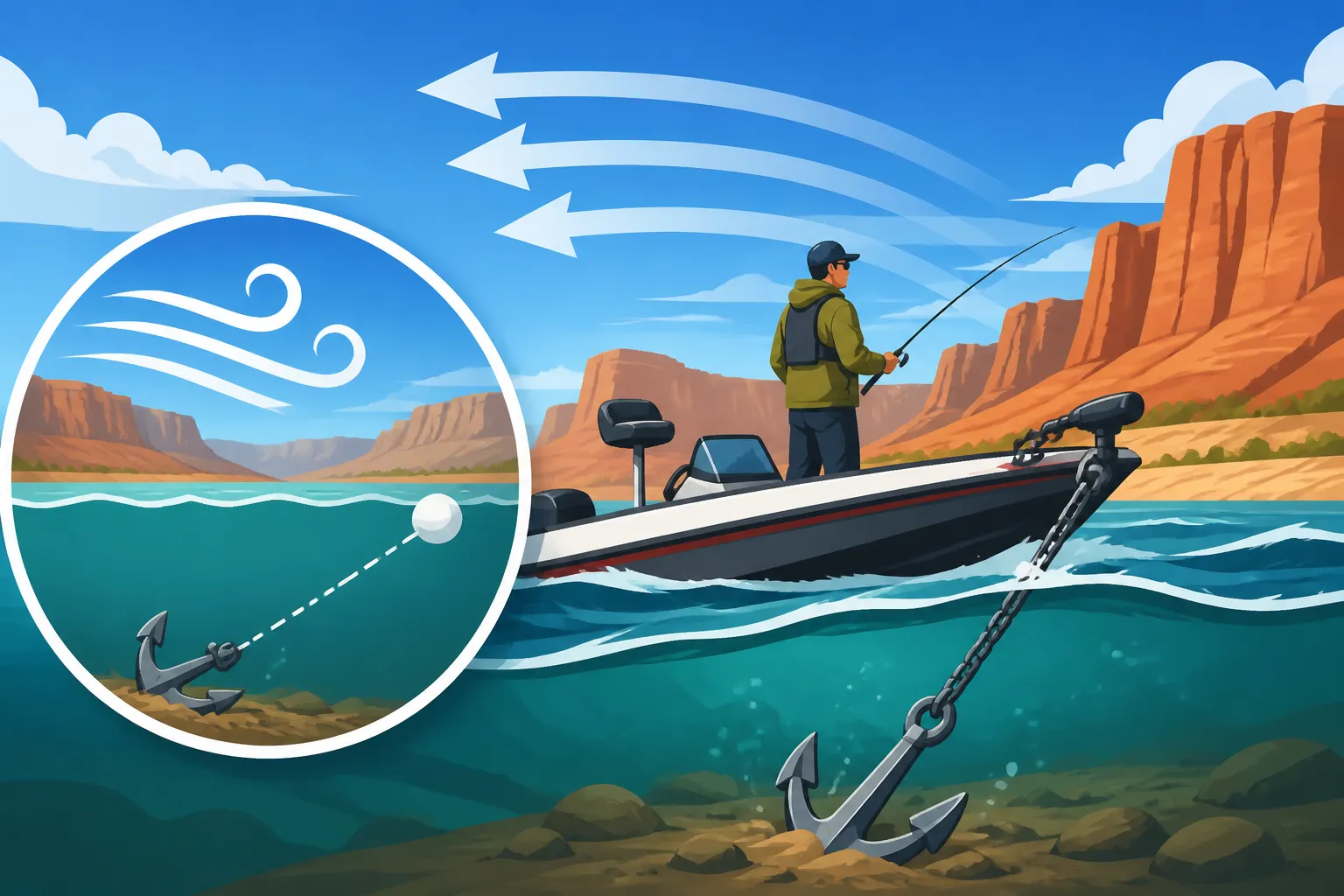
- Try a Tripping Line: If you're using a fluke anchor, one proactive measure is to attach a thin "tripping line" to the crown (the end opposite the flukes) of your anchor. Run this line back up to a small buoy or float. If the main anchor line gets stuck, you can pull on the tripping line, which will "trip" the anchor backward, hopefully freeing it. This needs to be set up before you drop anchor, of course.
- Change the Angle of Pull: If your anchor is stuck, try motoring your boat around the anchor in a wide circle, pulling from different directions. Sometimes, a change in the angle of pull is all it takes to free a fluke or claw that's wedged.
- Pull Straight Up: As a last resort, if you can motor directly over the anchor and pull straight up, the upward force might free it. Be careful doing this in a strong wind, as maintaining position directly over the anchor can be tricky and potentially dangerous. If all else fails, you may have to cut your line, which is why having an extra anchor on board, or considering a system like a Grapple anchor for extremely rocky areas, can be helpful.
Retrieving Your Anchor in Strong Wind
Pulling up a heavy anchor and hundreds of feet of chain and rope in strong wind can be exhausting and even dangerous if not done correctly.
- Motor Towards the Anchor: Use your boat's engine to motor slowly towards your anchor while simultaneously reeling in line. This takes the strain off your arms and puts it on your engine. Your goal is to get directly over the anchor.
- Use a Windlass: If you have a powered windlass, this is where it shines. Simply activate it and let it do the heavy lifting while you steer.
- Employ an Anchor Ball: If you're manually retrieving, an anchor ball is invaluable. Attach it as described earlier, motor forward with your boat, and let the buoy's lift and your boat's momentum pop the anchor free. This is especially useful in deep water or when the anchor is heavily set. You can find robust anchor balls and related retrieval tools on Amazon to simplify this process.
Advanced Tips and Considerations for Windy Utah Waters
Beyond the basics, there are some more advanced techniques and vital considerations that can further improve your anchoring success and overall safety when fishing Utah's gusty reservoirs.
Using a Second Anchor (Dual Anchoring)
Sometimes, one anchor just isn't enough, especially if you're trying to hold a precise position in strong, shifting winds, or if you're on an open water body like Strawberry Reservoir where the wind can really pick up. Dual anchoring provides significantly more stability and precise control.
- Bow and Stern Anchors: This is the most common dual anchoring method. Deploy a primary anchor from the bow, set it, and then drift back while paying out line until you're past your desired spot. Then, deploy a second, lighter anchor from the stern. This allows you to "pin" your boat between the two anchors, effectively eliminating swing and keeping you precisely on your target. It's particularly useful if you're trying to fish a very specific drop-off or structure.
- Two Bow Anchors (V-Shaped): In extremely strong winds, or if you want to spread out your boat's profile, you can deploy two anchors from the bow, setting them at an angle to each other (forming a "V" shape with your boat at the point). This distributes the load and can prevent one anchor from dragging. This method is often preferred for overnight stays or when you absolutely cannot afford to shift position.
Employing a Drift Sock or Drogue
While not an anchoring device in the traditional sense, a drift sock (also known as a drogue or sea anchor) is an invaluable tool for boat control in windy conditions, especially if you want to slow your drift while fishing or need some stability without being fully anchored.
- How They Work: A drift sock is a large, cone-shaped parachute-like device that you deploy from your boat. It fills with water and creates significant drag, slowing your boat's drift dramatically.
- Benefits in Wind: Instead of being blown across a fishing spot at an unmanageable speed, a drift sock allows you to slow down, present your lure or bait more effectively, and still cover a wide area. It's fantastic for trolling alternative routes or for just maintaining some semblance of control when the wind makes precise boat handling difficult. They also help point your boat into the wind, making the ride much smoother. You can connect to a drift sock through a sturdy cleat on your boat, and it often stores compactly.
Paying Attention to Forecasts and Water Conditions
This might seem obvious, but it's astonishing how many times anglers are caught off guard by a sudden change in weather. For anyone fishing Utah's large reservoirs, checking the weather forecast, particularly the wind forecast, is absolutely paramount.
- Pre-Trip Planning: Before you even leave the house, check multiple weather sources for your specific body of water. Pay close attention to sustained wind speeds and, more importantly, anticipated gust speeds. A sustained 10 mph wind is manageable; 25 mph gusts can be dangerous.
- On-Water Awareness: Once you're on the water, don't just rely on the morning forecast. Keep an eye on the sky. Dark clouds, sudden temperature drops, or changes in wind direction can all signal an impending squall. If the wind starts to pick up significantly, and you're unsure about your anchoring ability, it's always safer to head for a sheltered cove, a nearby marina, or even call it a day rather than risk your safety and your boat. Knowing when to quit is a sign of a seasoned angler. The article How Wind Affects Fishing on Utah Reservoirs can further elaborate on this.
By combining the right gear with smart techniques and a healthy respect for the power of the wind, you'll be well on your way to mastering anchoring on even the blusteriest of Utah reservoir days. Tight lines!
Disclaimer
This article is for general informational purposes only and does not constitute professional advice. Laws, prices and regulations vary by location and change over time. Consult a qualified professional for guidance on your specific situation.