Do You Need a Planer Board for Trolling Kokanee?
Oh, the age-old question that keeps many a Utah angler up at night: "Do I really need a planer board to catch Kokanee?" It's a common frustration, isn't it? You see all the fancy gear at Bass Pro Shops or online at Amazon, the endless discussions in forums, and you start to wonder if your current setup is just not cutting it. Especially when those elusive silver bullets known as Kokanee salmon are playing hard to get, it's easy to second-guess every piece of tackle. This guide is here to cut through the noise, validate your concerns, and help you understand when planer boards are a game-changer for Kokanee trolling in Utah, and when you might be just fine without them.
Understanding Kokanee Trolling Dynamics
Let's face it, Kokanee salmon are finicky fish. They're not like your average stocked rainbow trout that will hit almost anything. These landlocked sockeye have specific behaviors and preferences that make them a unique challenge for anglers. To truly understand the role of planer boards, we first need to grasp what we're trying to achieve when we troll for them.
The Challenge of Kokanee Behavior
Kokanee are primarily plankton feeders, which means they spend a lot of their time suspended in the water column, often in deeper, cooler waters, following their food source. They are also incredibly sensitive to disturbance. A boat passing directly overhead can spook an entire school, sending them scattering or diving deeper. Imagine trying to lure a shy deer in a crowded park; it's a similar principle. Your boat's shadow, the sound of your motor, even the vibrations through the water can be enough to make them wary. This sensitivity often dictates that your lures need to be presented away from the immediate vicinity of your boat.
Furthermore, Kokanee typically prefer smaller, flashy lures or dodgers and hoochies that mimic zooplankton or small invertebrates. They often hit these offerings when they're presented in a natural, undisturbed manner. If your line is dropping straight down from your boat, creating an unnatural angle and shadow, it can be a turn-off. Their delicate mouths also mean a subtle, consistent presentation is often key to enticing a bite and ensuring a solid hookup. This is where angling techniques like How to Troll for Kokanee in Utah become crucial, focusing on precision and stealth.
Why Spread Your Lures?
When you're trolling, the goal is to cover as much water as possible and present your lures to fish that might not be directly under your boat. If you're running multiple lines, having them all dropping straight back can lead to tangled messes, especially during turns or when you're fighting a fish. More importantly, it limits your "strike zone." Think of it like this: if you're trying to sweep a wide floor, you'd use a wide broom, not a tiny whisk.
Spreading your lures horizontally away from the boat accomplishes several things. First, it allows you to present multiple baits in a wider path, increasing your chances of intercepting a school of Kokanee. Second, it gets your lures into "fresher" water, away from the immediate disturbance of your boat, which, as we discussed, can be a major factor for skittish Kokanee. Third, a wider spread can help you identify a pattern faster. If you're getting bites consistently on the port side, or on a lure that's running further out, you can adjust your other lines accordingly. This strategic advantage is particularly important in larger reservoirs like Flaming Gorge or Strawberry Reservoir, where Kokanee populations can be vast but spread out.
Planer Boards: What They Are and How They Work
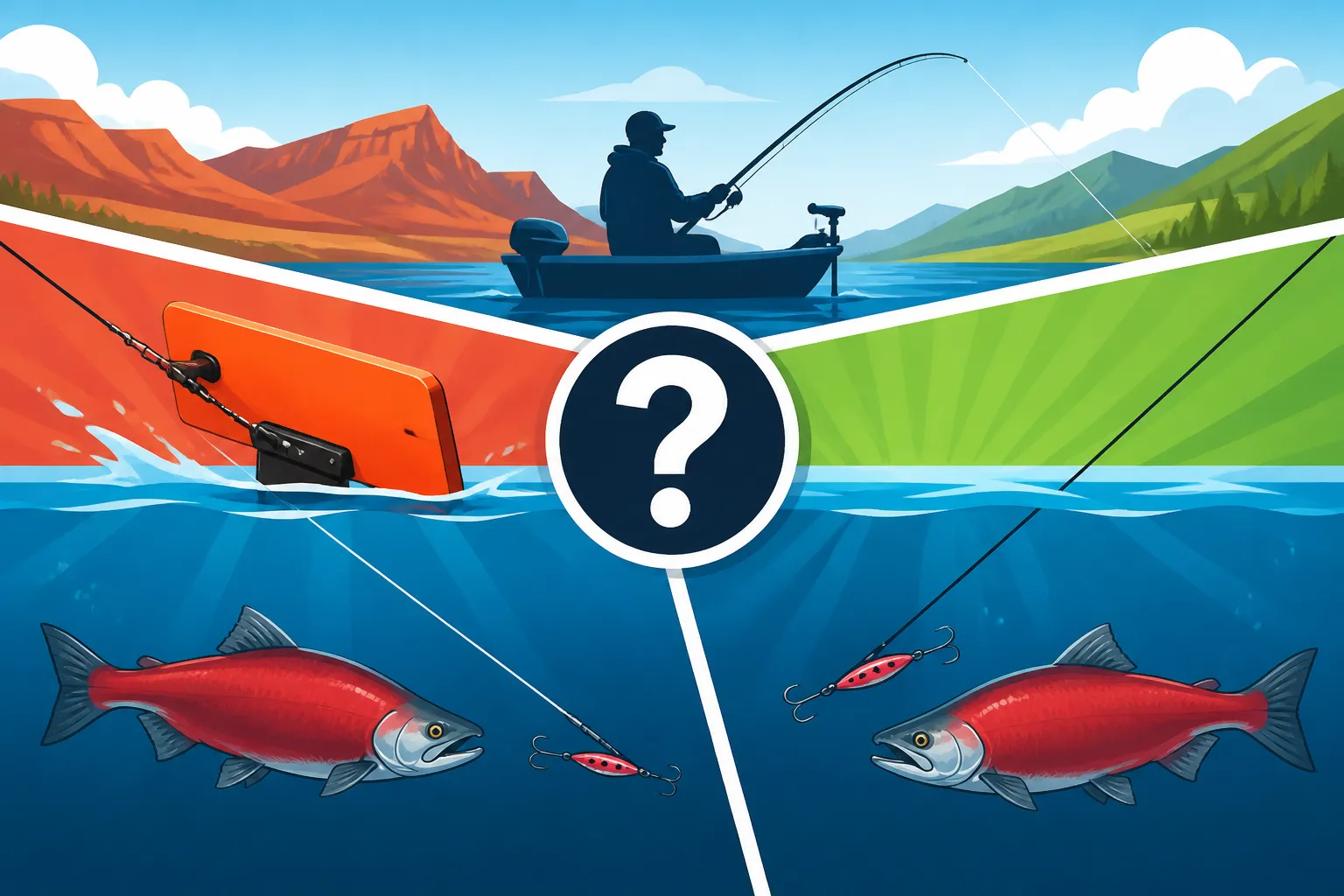
So, you're convinced that spreading your lures is a good idea. That's where planer boards come into the picture. They're ingenious devices designed to pull your fishing line out to the side of your boat, allowing you to cover a much wider swath of water than you could by simply trailing lines directly behind.
Types of Planer Boards for Kokanee
There are a few main types of planer boards, each with its own advantages, though for Kokanee, you'll typically see smaller, less aggressive boards than those used for, say, walleye on the Great Lakes.
- Inline Planer Boards: These are probably the most common for Kokanee and other inland trolling. An inline board attaches directly to your fishing line, ahead of your lure. As your boat moves forward, the board, shaped like a mini surfboard or torpedo, "planes" out to the side, pulling your line with it. When a fish strikes, the board often trips or releases, allowing you to fight the fish directly without the board putting too much resistance. Many models have adjustable clips to control how much tension it takes to release. Brands like Offshore Tackle and Church Tackle are popular choices you might find at Bass Pro Shops. They're relatively easy to deploy and retrieve, making them great for smaller boats or when fishing solo.
- Mast and Line Planer Boards: These are more common on larger boats targeting bigger game fish or when running many lines. They involve a mast mounted to the boat, from which a main line extends to a large "tow" planer board (or pair of boards). Individual fishing lines are then clipped onto this main tow line, with special releases that allow the fishing line to detach when a fish hits. While highly effective for a massive spread, they are generally overkill and more cumbersome for typical Kokanee fishing in Utah's reservoirs, where most anglers are running 2-4 lines per person, perhaps How Many Ice Fishing Rods Can You Use at Once in Utah? when ice fishing, but not quite that many while trolling.
The Mechanics of Spreading Your Spread
Regardless of the type, the core function is the same: to move your line horizontally away from your boat. The amount of "spread" you get depends on several factors: the size and design of the planer board, the length of line you let out from the board to your lure, and your trolling speed.
When you deploy an inline planer board, you'll attach your line to a front clip, let out some line, and then attach it to a rear clip (or a single clip on some designs). As you move, the board catches the water and pulls itself away from the boat. You can then let out more fishing line, and your lure will follow the board, tracking out to the side. The beauty of this system is that it allows you to run multiple lines side-by-side, each at a different distance from the boat, without crossing them. You can also vary the depth of your lures by adjusting the amount of line you let out, or by adding weights, diving planes, or How to Downrig for Lake Trout if you're targeting specific depths.
For Kokanee, this means you can have one lure 30 feet to the port side, another 50 feet to starboard, all while keeping them away from the boat's disturbance. This subtle presentation can be exactly what shy Kokanee need to commit to a strike. The wider spread also means you're not just fishing a narrow path directly behind your boat, but exploring a much larger underwater landscape, increasing your chances of finding scattered schools of Kokanee.
When Planer Boards Are Really Necessary for Kokanee
Okay, so they're cool, they spread your lines – but do you absolutely need them for Kokanee in Utah? The honest answer is: it depends. There are certainly situations where they become incredibly beneficial, almost to the point of being a necessity for consistent success.
High-Pressure Waters and Wary Fish
Utah's most popular Kokanee fisheries, like Strawberry Reservoir, Flaming Gorge, and Jordanelle, can see a lot of angler traffic, especially on weekends and during prime seasons. When countless boats are constantly churning the water, driving over the same productive areas, the Kokanee in those waters become educated, or as we like to say, "wary." They learn to associate boat noise and shadows with danger.
In these high-pressure scenarios, getting your lures out and away from the boat's path can make all the difference. Imagine a school of Kokanee deep down, watching boats pass overhead. A lure directly behind a boat might look suspicious, but one drifting 50 feet to the side, seemingly alone in the water column, could appear much more natural and enticing. This separation allows the fish to approach the lure without the immediate threat of the boat's presence. For these conditions, having a planer board setup can genuinely increase your hook-up rates, turning a slow day into a productive one. It's about presenting your bait to unmolested fish, which is crucial when fishing for sensitive species.
Boat Traffic and Noise Mitigation
Let's stick with those busy waters. Not only are the fish wary, but you also have to contend with other boats. Trolling a tight spread directly behind your boat limits your ability to avoid tangles with other anglers, or even makes it harder to maneuver around obstacles or other boats.
Planer boards, by extending your fishing lines horizontally, give you a larger "buffer zone" between your boat and your lures. This can be invaluable in crowded areas. It allows you to run multiple lines more safely, reducing the risk of them getting snagged on another boat's lines or props. More importantly, it directly addresses the noise and disturbance factor. Your boat's prop wash and engine noise create a cone of disturbance directly behind and beneath your boat. Getting your lures outside of this cone means they're running in quieter, less turbulent water. This subtle difference can be the trigger for a bite from a Kokanee that would otherwise have ignored your offering. It's similar to How Water Temperature Affects Utah Trout Fishing – small environmental changes can have a big impact on fish behavior.
Maximizing Your Spread Without Downriggers
While downriggers are fantastic for precise depth control, especially for deep-holding Kokanee and How to Downrig for Lake Trout, they don't offer the same horizontal spread as planer boards. A downrigger typically keeps your line directly beneath or slightly behind the boat, albeit at a specific depth. If you're running multiple downriggers, they're still largely operating within the boat's immediate footprint.
Planer boards excel when your primary goal is to cover width. They allow you to present a "wall" of lures across the water, rather than just a narrow column. This is particularly useful when Kokanee are scattered or when you're trying to locate schools. If you don't have downriggers or only have one, planer boards offer a powerful way to expand your fishing zone. You can combine them, too: a downrigger for deep, central presentations, and planer boards for shallower, wider sweeps. This combination allows for maximum coverage, both vertically and horizontally, which is often the key to cracking the code on a tough Kokanee day. For anglers looking to diversify their tackle, checking out options for Best Trolling Motors for Utah Reservoirs can also enhance stealth and presentation control.
Alternatives to Planer Boards and When They Suffice
While planer boards offer significant advantages, they aren't always the only answer. Many successful Kokanee anglers in Utah still do quite well with alternative methods or a more simplified approach. Understanding these alternatives will help you decide if planer boards are truly worth the investment for your specific fishing style and local conditions.
Flat-Lining and Long-Lining Techniques
The most basic alternative to planer boards is simply "flat-lining" or "long-lining." This involves letting out a significant amount of line directly behind your boat, allowing your lure to run at a relatively shallow depth or whatever depth a weight (like a small banana weight or a bell sinker) pulls it to. For deeper presentations without additional gear, some anglers use lead core line, which sinks as more line is deployed.
Flat-lining works best when Kokanee are actively feeding near the surface or are not particularly boat-shy. In less pressured waters, or during times of low boat traffic (think early weekdays or late evenings), simply getting your lure away from the prop wash by letting out a long line can be enough. This technique is also effective for targeting Kokanee during their pre-spawn staging when they might be found shallower. The key is to run your lines really long – often 100 feet or more – to ensure the lure is well out of the boat's immediate disturbance zone. While it doesn't give you the lateral spread of planer boards, it's a simple, effective, and gear-minimal approach that many anglers have mastered for specific conditions. If you're just starting, getting the right Gear You Need to Fish From a Float Tube in Utah for shallow trolling can be a great entry point.
Downriggers and Their Role
As mentioned, downriggers are incredibly effective tools for Kokanee fishing, especially when fish are holding deep and at specific depths. A downrigger allows you to send a heavy weight (the cannonball) down to a precise depth, with your fishing line clipped onto a release mechanism. Your lure then trails behind the cannonball at that exact depth. When a fish strikes, the line releases from the clip, and you fight the fish directly.
Downriggers offer unparalleled depth control, which is often critical for Kokanee that school tightly at certain thermocline levels. If your fish finder (and you should definitely have one; consider Best Fish Finders for Utah Reservoirs) shows Kokanee consistently at, say, 40 feet, a downrigger is the most efficient way to present your lure precisely at that depth. While they don't provide the wide horizontal spread of planer boards, they can be combined effectively. Many anglers will run one or two downriggers for precise depth, and then deploy planer boards for wider, shallower presentations, covering both dimensions simultaneously. Knowing How Many Downriggers You Need for Trolling Kokanee can help you plan your setup.
The Value of Simplicity
Sometimes, less is more. For beginners, or those who prefer a more relaxed fishing experience, a complex planer board setup with multiple lines and releases can feel overwhelming. Starting with a simpler approach allows you to focus on fundamental trolling techniques, understanding trolling speed (What Trolling Speed Works Best for Kokanee Salmon?), lure selection (Best Spoon Size for Kokanee), and reading your fish finder.
Many anglers find plenty of success with just a few rods, using either lead core line or small trolling weights to get their lures to the desired depth. This approach is easier to manage, requires less initial investment in gear (though you can find planer boards at various price points at places like Amazon), and can still be highly effective, especially in less pressured waters or if you're targeting aggressive Kokanee during certain feeding windows. It also means less time spent rigging and more time with a line in the water, which is often the best strategy for kids or those looking for a stress-free outing.
Here's a quick comparison of these trolling strategies for Kokanee:
| Trolling Method | Primary Benefit | Key Feature | Ideal Scenario | Downsides |
|---|---|---|---|---|
| Inline Planer Boards | Wide horizontal spread, stealthy presentation | Attaches directly to fishing line, pulls out to side | Wary fish, high boat traffic, scattered schools | Can be more complex to set up, added gear |
| Mast Planer Boards | Massive horizontal spread for many lines | Main line from mast, clips for individual lines | Very large boats, extensive spreads (less common for Kokanee) | Overkill for most Kokanee setups, expensive |
| Flat-Lining/Long-Lining | Simplicity, minimal gear, natural drift | Long line behind boat, little to no weight | Less pressured waters, surface-feeding Kokanee | Limited depth control, narrow strike zone |
| Downriggers | Precise depth control | Cannonball weight, release clip | Deep-holding Kokanee, specific thermoclines | Limited horizontal spread, more expensive gear |
In conclusion, while planer boards aren't always a non-negotiable item for every single Kokanee outing, they are undeniably a powerful tool that can significantly enhance your success, particularly when facing educated fish, heavy boat traffic, or when you need to cover a vast amount of water. For a serious Kokanee angler in Utah, they're a valuable addition to the arsenal.
Disclaimer
This article is for general informational purposes only and does not constitute professional advice. Laws, prices and regulations vary by location and change over time. Consult a qualified professional for guidance on your specific situation.