Best Fish Finder Frequency for Deep Utah Reservoirs
It's incredibly frustrating, isn't it? You head out to one of Utah's vast, deep reservoirs like Flaming Gorge or Bear Lake, full of hope, only to spend hours staring at a blank screen on your fish finder, wondering if there are even any fish down there. The truth is, sometimes the fish are there, but your fish finder isn't set up to see them effectively in those challenging deep-water conditions. This guide will cut through the technical jargon and explain exactly which fish finder frequencies are best for conquering Utah's deep reservoirs, helping you unlock the secrets hidden beneath the surface.
Decoding Fish Finder Frequencies: The Basics for Deep Water Angling
Before we dive into the nitty-gritty of specific frequencies, let's get a basic understanding of what fish finder frequencies actually are and how they interact with the water column. Think of your fish finder as a sophisticated underwater flashlight, sending out sound waves (pings) and listening for the echoes that bounce back from fish, structure, and the bottom. The "frequency" refers to how many sound waves are sent per second. This isn't just a number; it dictates how well your unit can penetrate deep water versus how much detail it can show you.
What is Sonar Frequency, Anyway?
In simple terms, sonar frequency is measured in kilohertz (kHz). Common frequencies you'll see on consumer fish finders range from 50 kHz to 200 kHz, but modern units often include even lower or higher options, sometimes into the megahertz range for specialized applications. Each frequency has its own unique characteristics, making it better suited for certain situations. A lower frequency sound wave, like 50 kHz, acts like a broad, powerful beam of light that can cut through a lot of darkness. A higher frequency, like 200 kHz, is more like a focused spotlight, offering sharp detail but over a smaller area. Knowing this basic principle is your first step to choosing the right tool for the job when you're targeting those elusive deep-water fish.
The Trade-Off: Coverage vs. Detail
This is the core concept to grasp when selecting a frequency for deep Utah reservoirs. You're constantly balancing two critical factors: how wide an area your sonar beam covers (coverage) and how clearly it defines targets within that area (detail or target separation).
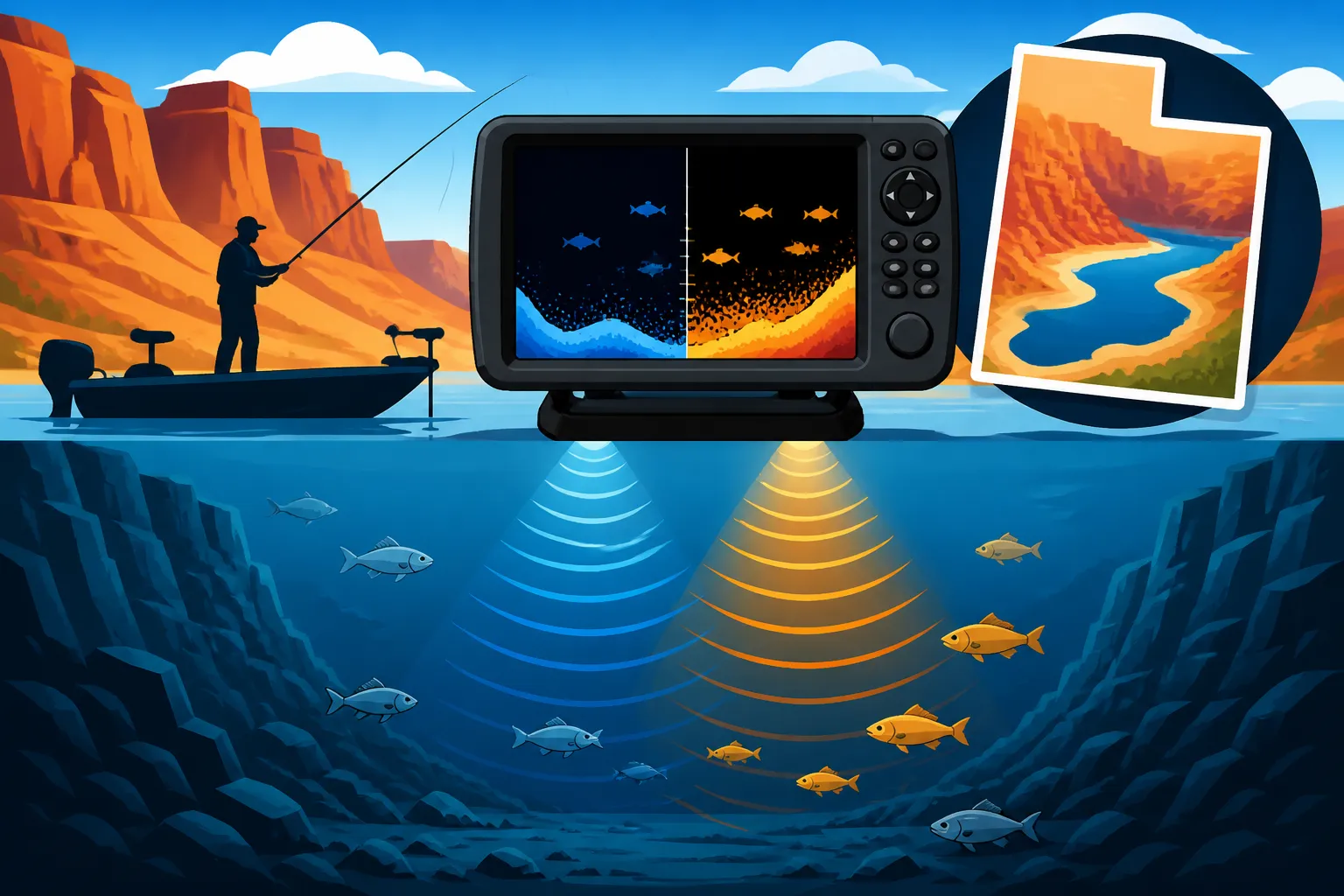
- Low Frequencies (e.g., 50 kHz): These frequencies penetrate deeper into the water column and provide a wider cone angle, meaning they "see" a larger area under your boat. This is fantastic for scanning vast areas of Flaming Gorge fishing guide or Bear Lake fishing guide to locate schools of baitfish or general structure. However, the trade-off is less detailed resolution. You might see a "blob" that indicates fish, but distinguishing individual fish or identifying specific species can be challenging. Think of it as a wide-angle photograph—you get the whole landscape, but individual leaves aren't in sharp focus.
- High Frequencies (e.g., 200 kHz): These frequencies have a narrower cone angle, providing a more focused beam. This results in superior target separation and detail, making it easier to see individual fish arches, distinguish fish from submerged trees, and get a clearer picture of the bottom composition. The drawback, especially in deep water, is reduced depth penetration and a smaller area covered. It's like a telephoto lens—you get incredible detail on one specific object, but you might miss what's happening just outside that narrow frame.
For Utah's deep reservoirs, where you're often looking for fish holding near structure hundreds of feet down, this trade-off becomes critical. You need to decide if you want to find anything down there over a wide area, or if you want to meticulously pick apart a smaller section for subtle details.
The Power of Low Frequencies in Deep Utah Reservoirs
When you're out on the immense expanse of Lake Powell or plumbing the depths of Strawberry Reservoir for Utah Lake Trout Mackinaw Guide, low frequencies are often your best friend. They are built for serious depth and broad coverage, which are non-negotiable attributes for navigating these immense bodies of water.
Why 50 kHz is Your Deep-Water Ally
The 50 kHz frequency is a stalwart in deep-water fishing, and for good reason. Its longer sound waves are simply more capable of penetrating hundreds of feet of water, making it far more effective than higher frequencies at reaching the bottom in places where the depth drops off dramatically. Imagine you're fishing for How to Fish Deep Water for Summer Lake Trout at Flaming Gorge, where depths can easily exceed 200-300 feet. A 50 kHz beam spreads out more as it descends, creating a wider cone angle at the bottom. This larger "footprint" allows you to cover a significant amount of water with each ping, increasing your chances of detecting fish or structure that might otherwise go unnoticed.
This broad coverage is invaluable for:
- Locating schools of baitfish: Deep water often means pelagic fish, like kokanee salmon or lake trout, are chasing bait schools suspended in the water column. A 50 kHz beam can easily pick up these large aggregates, even if they're hundreds of feet down.
- Mapping the general bottom contour: While not providing hyper-detailed images, 50 kHz is excellent for understanding the overall shape of the lakebed—identifying sharp drop-offs, expansive flats, or large humps without missing big features.
- Trolling large areas: When you're covering miles of water, Utah trolling techniques for lake trout or looking for active fish, a wide beam ensures you're not missing potential targets just outside a narrower cone. Many anglers use 50 kHz specifically for this broad search, then switch to a higher frequency if they mark something interesting.
When you're staring at depths that make your head spin, especially at the Flaming Gorge fishing guide or Bear Lake fishing guide, seeing something is often better than seeing nothing, and 50 kHz delivers that foundational visibility.
When Lower Frequencies Fall Short
While 50 kHz is a champion for deep penetration and wide coverage, it's not a silver bullet. The very nature of its long, powerful sound waves means a compromise in resolution. Here's where lower frequencies can leave you wanting more:
- Poor target separation: Because the beam is so wide and the sound waves are longer, distinguishing individual fish from each other, or separating a fish from a piece of structure directly next to it, becomes incredibly difficult. You might see a large, amorphous blob on your screen and wonder if it's a school of small fish, a few large fish, or just a submerged log. This can be particularly frustrating if you're trying to target specific fish in a cluttered area, like a deep brush pile.
- Reduced detail of structure: While you can see the overall bottom contour, don't expect to see the intricate details of a rock pile or the individual branches of a submerged tree. A 50 kHz frequency will show you the "mountain," but not the specific "trees" on it. For anglers who rely on precise structure fishing, this lack of detail can be a significant handicap.
- Surface clutter interference: In some conditions, especially with choppy water or a lot of debris, the wide beam of a low frequency can pick up more surface clutter, making the top few feet of the water column harder to interpret. While fish finders have settings to mitigate this, it can still be more pronounced with wider, lower-frequency beams.
Ultimately, 50 kHz is for broad strokes, for identifying the presence of fish or significant changes in depth. If you need to know what those fish are doing, or precisely where they are in relation to a specific piece of structure, you'll likely need to complement it with a higher frequency.
High Frequencies: Clarity and Target Separation in the Depths
While low frequencies dominate the conversation for sheer depth penetration, don't discount the value of higher frequencies, even when fishing Utah's deepest reservoirs. They bring a level of clarity and precision that low frequencies simply cannot match, especially when you need to confirm what you're seeing or precisely target fish.
The Precision of 200 kHz and Beyond
Frequencies around 200 kHz are often considered the sweet spot for many freshwater anglers, offering a good balance of depth capability (in most shallow to moderate depths) and excellent detail. In deep Utah reservoirs, while a 200 kHz beam won't penetrate as far as 50 kHz, its narrower cone angle and shorter sound waves provide superior target separation.
Consider fishing a deep rock pile or a submerged cliff face, common features in places like Deer Creek Reservoir or even the deeper sections of Jordanelle Reservoir. With a 200 kHz frequency, you can:
- Identify individual fish arches: Instead of a fuzzy blob, you're more likely to see distinct arches for individual fish, allowing you to count them and get a better sense of their size. This is crucial for distinguishing between a school of smaller baitfish and a few larger predatory trout.
- Differentiate fish from structure: A 200 kHz beam can help you see if those marks are actually fish holding tight to a rock or if it's just the rock itself. This precision helps prevent wasted casts on non-existent targets.
- Uncover subtle bottom details: While 50 kHz shows the overall bottom, 200 kHz can reveal finer textures, like whether the bottom is soft mud, hard rock, or scattered gravel. This information can be vital for certain species or bait presentations.
This level of detail is a game-changer when you've already located a general area with your wider, lower-frequency beam and now need to zero in on the exact location of the fish. It's about confirming the "what" and "where" once the "something is here" has been established.
Using High Frequencies for Specific Targets Even in Deep Water
Even when you're in hundreds of feet of water, higher frequencies still have a crucial role, especially when paired with a good transducer. They allow for highly targeted fishing once you've located a promising area.
For instance, imagine you're slow-trolling or jigging for large Mackinaw (Lake Trout) size records in Utah in 150 feet of water at Flaming Gorge. Your 50 kHz beam shows a promising school of fish in the mid-column. Switching to or simultaneously using 200 kHz can:
- Pinpoint the strike zone: The narrower beam of 200 kHz will show you the precise depth of the fish, allowing you to set your downrigger or jig depth with pinpoint accuracy. This can be the difference between getting a bite and just dragging your lure through empty water.
- Observe fish reactions to your lure: With a high-resolution 200 kHz display, you can sometimes even see your lure dropping into the fish zone and observe how fish react to it. Do they rise to meet it? Do they ignore it? This real-time feedback is invaluable for adjusting your presentation. This kind of nuanced observation is much harder with the broader, less detailed view of lower frequencies.
- Identify thermoclines and subtle baitfish schools: While both frequencies can show these, the clarity of 200 kHz makes it easier to discern layers of temperature changes or tightly packed schools of shad or minnows that larger predatory fish are targeting.
Many seasoned anglers, when they find a promising deep spot, will often use their highest frequency to confirm the presence and behavior of fish before dropping their lines. It's all about gaining that extra edge in understanding the underwater world.
Dual and CHIRP Sonar: The Ultimate Solution for Utah's Deep Lakes
Let's face it, having to choose between depth penetration and detail is a compromise no angler truly wants to make, especially on Utah's stunning but challenging deep waters. Thankfully, modern technology has largely solved this dilemma with dual-frequency and CHIRP sonar systems, giving you the best of both worlds.
Combining Strengths with Multi-Frequency Systems
Most quality fish finders designed for serious anglers on large bodies of water today offer either dual-frequency capabilities or CHIRP sonar, or often both.
-
Dual-Frequency Sonar: This allows you to either switch between two distinct frequencies (e.g., 50 kHz and 200 kHz) with the press of a button, or even view both frequencies simultaneously in a split-screen display. This is incredibly powerful for deep-water fishing. You can run 50 kHz on one side of your screen for broad area scanning, getting that wide cone angle to locate major schools or structure, and simultaneously run 200 kHz on the other side for a more detailed, narrower view of what's directly below your boat. If your 50 kHz screen shows a large mark, you can instantly check the 200 kHz screen to see if it resolves into individual fish or if it's just a large, soft target. This setup is a favorite for How to Read a Fish Finder for Utah Reservoirs and Utah Trolling Techniques for Lake Trout.
-
CHIRP Sonar: This is where technology really shines. Instead of sending a single-frequency pulse, CHIRP (Compressed High-Intensity Radiated Pulse) sonar sends a continuous sweep of frequencies, from low to high, with each pulse. The receiver then processes the return frequency from each target across that entire band. The result? Unprecedented target separation, clarity, and depth penetration all at once. It's like having every single frequency working for you simultaneously, giving you a picture that's almost photographic in its detail. With CHIRP, you can often see individual fish arches clearer, separate baitfish from game fish more easily, and get a much crisper view of bottom structure even in very deep water. When you're looking for Best Fish Finders for Utah Reservoirs, CHIRP capability should be high on your list.
Many advanced units from brands you might find at Bass Pro Shops or online at Amazon will boast these features, making them ideal for the demands of Utah's deepest lakes.
Getting the Most from Your Advanced Sonar Unit
Having a dual-frequency or CHIRP unit is one thing; knowing how to use it effectively in deep water is another. Here are some tips to maximize your investment:
- Understand Your Cone Angles: Even with multi-frequency, remember that lower frequencies have wider cone angles and higher frequencies have narrower ones. Familiarize yourself with how wide your beam is at different depths. For example, a 200 kHz beam might only be 10 feet wide at 100 feet deep, while a 50 kHz beam might be 40 feet wide at the same depth. This helps you interpret what you're seeing in relation to your boat's position.
- Experiment with Display Modes: Don't just stick to one view. Try split-screen options (e.g., 50/200 kHz side-by-side or CHIRP sonar with a traditional 2D sonar). Many units also offer customizable layouts.
- Adjust Sensitivity and Gain: In deep water, you'll often need to increase your sensitivity or gain to pick up faint returns from fish. However, too much can introduce clutter. It's a fine balance you'll learn through practice. Don't be afraid to tweak these settings as depth or conditions change.
- Use Zoom and Bottom Lock: When you mark fish deep, zoom in on that area of the water column to get a clearer, more magnified view. Bottom Lock mode can also be helpful, showing you the water column directly above the bottom, often where deep-dwelling fish like lake trout will be holding.
- Pair with Quality Transducers: Your fish finder unit is only as good as its transducer. For deep water, you'll want a high-quality, through-hull or transom-mount transducer specifically designed for deep-water performance and multi-frequency or CHIRP capabilities. A cheap transducer will limit even the best head unit. You can find excellent options for Best Boats for Utah Reservoir Fishing at places like Bass Pro Shops.
By understanding and utilizing these advanced sonar capabilities, you'll go from simply seeing vague marks to confidently identifying fish, discerning their depth, and even observing their behavior, making your deep-water angling in Utah far more productive. For more technical insights, explore How Deep Should You Set a Downrigger for Flaming Gorge Lake Trout.
Choosing the Right Frequency for Your Utah Reservoir
Now that you understand the nuances of different frequencies, let's bring it back to practical application for fishing Utah's varied and often deep waters. The "best" frequency isn't always a static answer; it depends on the specific conditions and what you're trying to achieve.
Matching Frequency to Depth and Target Species
The key to success is to adapt. Here's a quick guide to help you decide:
-
Extremely Deep Water (200+ feet): For vast, deep lakes like Flaming Gorge, Lake Powell, or Bear Lake when targeting suspended lake trout or kokanee salmon, low frequencies (like 50 kHz) are your primary search tool. They give you the broad picture, helping you find schools or significant structure quickly. If your unit has CHIRP, let it do its magic across a wide band for the best overall view. Once you mark something, a dual-frequency unit allows you to zoom in with a higher frequency for more detail without losing your deep-water visibility. Check out How Deep Do Lake Trout Live in Summer for more species-specific information.
-
Moderate Depths (50-200 feet): In many of Utah's popular reservoirs like Strawberry Reservoir, Fish Lake, or Deer Creek, you'll often be fishing depths in this range. Here, dual-frequency or CHIRP units truly shine. You can run 50 kHz for wider coverage and deeper penetration, but the 200 kHz will be much more effective for identifying individual fish, distinguishing between different species, and picking out finer details of submerged structure. This is especially useful if you're targeting a mix of trout, kokanee, or even bass holding to ledges.
-
Shallow Water (Under 50 feet): While not the focus of "deep reservoirs," it's worth noting that if you venture into shallower bays or coves, higher frequencies (200 kHz and above) are generally superior. They offer maximum detail and target separation, which is crucial for picking out fish around weeds, docks, or rocky shorelines. Even on deep lakes, if you're fishing a shallow flat or a distinct break, don't be afraid to switch to a higher frequency for that localized detail. For smallmouth bass in rocky coves, for example, 200 kHz will give you a clear advantage.
Practical Application: A Quick Reference Table
To make this easier to digest, here’s a simple comparison to help you choose your frequency, especially for those deep Utah reservoir adventures:
| Feature/Condition | Lower Frequencies (e.g., 50 kHz) | Higher Frequencies (e.g., 200 kHz) | CHIRP/Dual-Frequency Sonar |
|---|---|---|---|
| Depth Penetration | Excellent (goes very deep, hundreds of feet) | Good (effective in shallow to moderate, struggles in extreme deep) | Excellent (best of both, maintains depth and detail) |
| Cone Angle / Coverage | Wide (sees a large area under the boat) | Narrow (focused beam, smaller area) | Variable (can display wide and narrow, or sweep across for comprehensive view) |
| Target Separation | Poor (fish appear as blobs, hard to distinguish individuals) | Excellent (clear fish arches, good for individual fish) | Superior (clearest separation, almost photographic detail) |
| Bottom Detail | General contour, large features | Fine detail, texture, individual rocks/branches | Exceptional (reveals subtle changes, structure, and bottom hardness) |
| Best Use Case | Broad search in deep water, finding large schools, general contouring | Pinpointing individual fish, shallow water detail, structure identification | All-around best for deep reservoirs, combining wide search with detailed target identification |
| Example Utah Lakes | Flaming Gorge, Bear Lake, Lake Powell (main search) | Strawberry, Deer Creek, Jordanelle (detail & moderate depth) | All deep Utah reservoirs (optimal performance) |
Remember, the goal is to see the fish, and often, that means having the versatility to use the right tool for the specific depth and situation. Investing in a fish finder that offers dual-frequency or CHIRP capabilities will give you the most flexibility and the best chance of success when navigating Utah's incredible, deep fishing waters. For more on getting your boat ready, check out Utah Boat Registration and Safety Gear. Tight lines, friends!
Disclaimer
This article is for general informational purposes only and does not constitute professional advice. Laws, prices and regulations vary by location and change over time. Consult a qualified professional for guidance on your specific situation.